

"We dream big": Faroe Islands chase first-ever World Championship appearance
05 May. 2026
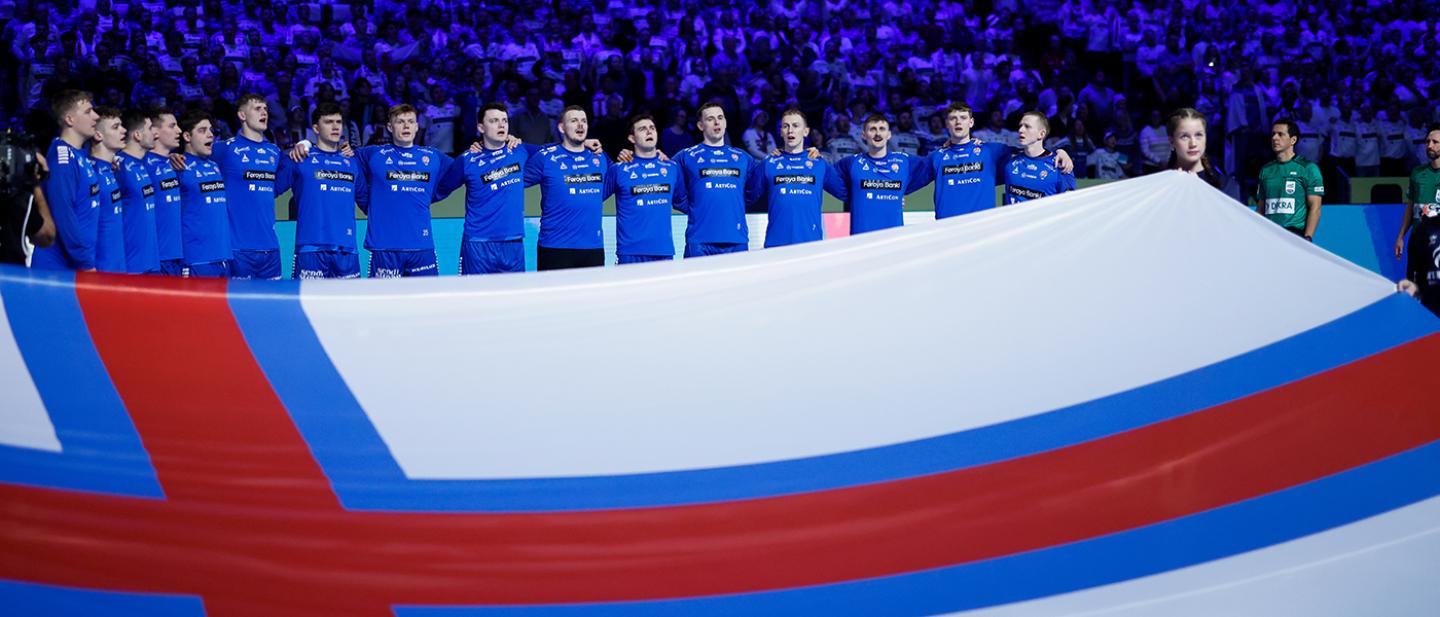
Last year, the Faroe Islands wrote history, by securing their first-ever medal in a World Championship, finishing third at the 2025 IHF Men’s Junior World Championship. It has been a stellar achievement and a testament of the things to come from this small, but plucky nation, with a population of 54,000.
Still, the Faroe Islands are making progress in the senior category too. They managed to secure qualification for the first major international competition in 2024, the EHF EURO, when they finished 20th. This January, they clinched their first win at the EURO and ended up on the 13th place.
And now, they aim for another milestone: their first appearance at the IHF Men’s World Championship.
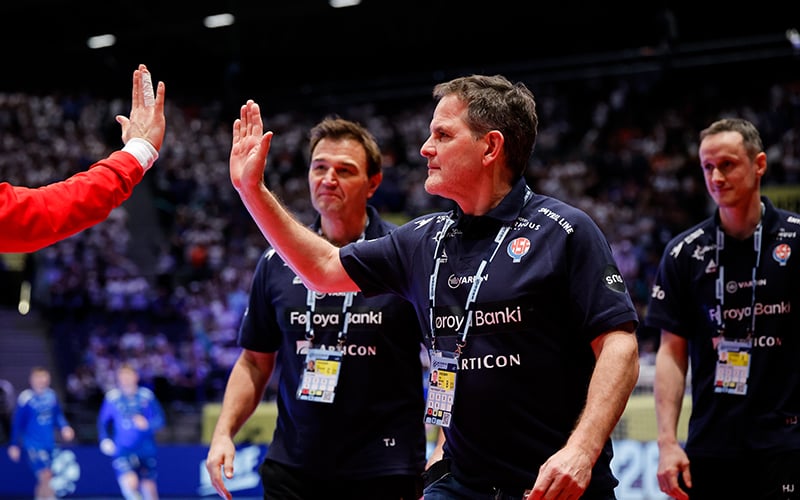
“It's a big objective for us. We have been amazing in these past years at the European Championship and also in the younger age categories. We dream about reaching our first appearance at the World Championship. Of course, that would be a big achievement, a big goal for us. We have managed to qualify a couple of times for the EURO, and now we want to succeed in moving on to the World Championships,” says Faroe Islands’ coach, Peter Bredsdorff-Larsen, for ihf.info.
To underline how much the Faroe Islands have progressed, just a stroll through their last qualification campaigns for the IHF Men’s World Championship is enough. Take, for instance, Egypt 2021. They entered the Qualification Europe Phase 1, where they lost against Lithuania and Slovakia and only beat Luxembourg.
For Poland/Sweden 2023, their draw did not provide any chance – facing Germany, the Faroe Islands lost 53:67 on aggregate. For the previous edition, Croatia/Denmark/Norway 2025, Faroe Islands lost by a single goal on aggregate, 60:61, against Kiril Lazarov’s side, after winning the first leg, 34:27.
Therefore, the process was painful, with some tough losses, but also with a lot of experience under their belt for these young players, which have provided some fantastic displays.
“Of course, it's a very young team. We have now been together for five years around the senior national team, and most of them are still 22 or 23 years old. So it's a very young team, but at this early stage of their careers, they are quite experienced. They have been through several youth World Championships and also two senior European championships, so we are becoming a more and more experienced team. Every time we qualify and compete, we move forward with more experience and more knowledge of how to play international handball, and that becomes an advantage for us, even though we are very young,” adds Peter Bredsdorff-Larsen.
“This very young team has many years in front of them. You have not seen the last of the Faroe Islands. We cannot be sure there will be as much talent in the next generations, but there will be more to come. More talents are on their way, and the coming five to ten years for the national team look bright.”
And indeed it looks. Elias Ellefsen á Skipagøtu will turn 24 in two weeks’ time and he has been already playing for THW Kiel for three years. He was the All-Star centre back and the top scorer at the 2023 IHF Men’s Junior World Championship.
His cousin, Óli Mittún, was the top scorer of the 2023 IHF Men’s Youth World Championship, the top scorer of the 2025 IHF Men’s Junior World Championship and the MVP of the latter competition.
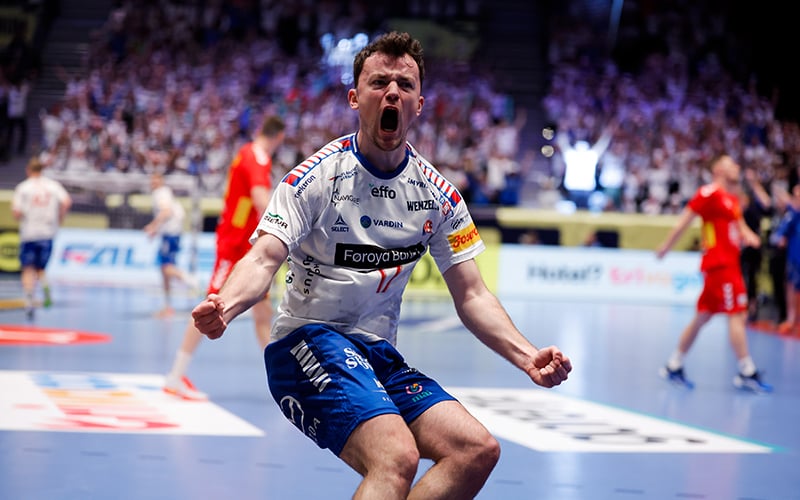
Such talent is hard to even find for Denmark, Germany or France, powerhouses of the continent, in consecutive generations and regardless of both being centre backs, they can be accomodated into the same time on the court, creating a dual-pronged attack which is impossible to stop at times.
And that comes also from the gyms throughout the Faroe Islands being open 24/7, so any kid can come and try to play handball, spending his time with his friends in the arena, as well as being instilled a cultural and tactical identity, which are paramount for the sport in the country.
“We are trying to compete with our competitive advantages, and those are courage, one-on-one situations and speed. We have made seven against six our game, and we are continuously working on developing it further and taking it closer to perfection. That has become our advantage and our way to compete against even the strongest nations. I would also add that the data from the Euros showed we are a team that takes shots from a very short distance. That also reflects our strengths. We are not a shooting team, we may not have international-level shooters in the traditional sense, so we try to build a style of play that fits us and makes it possible to compete at the international level,” says Faroe Islands’ coach.
This cultural development also is crucial for younger players in the Faroe Islands making the next step. Albeit handball clubs have been getting better and better, players need to leave home to Denmark, Iceland, Sweden or Germany to really improve and gain experience in the top leagues in the world.
Mittún, who is still 20 years old, has signed for IK Sävehof when he was only 17 years old, moving to Sweden. Now he is featuring at GOG Håndbold, the team which propelled Mathias Gidsel onto the big stage.
The centre back basically followed in the footsteps of Ellefsen á Skipagøtu, who went to Sävehof when he was 18 years old, spent three years and then signed for THW Kiel. Hákun West Av Teigum also plays for Füchse Berlin, while line player Ísak Vedelsbøl, crucial for the Faroe Islands in the bronze-winning campaign, also is featuring now for Sävehof.
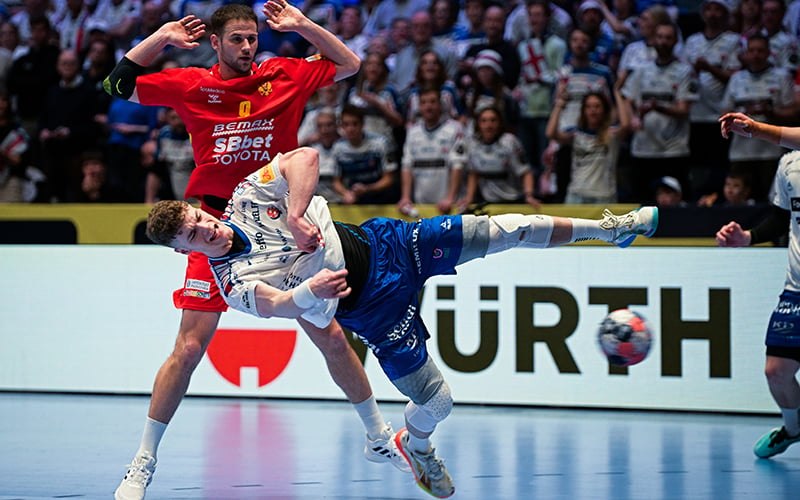
But now, the Faroe Islands are in a primed position to make their debut at the World Championship, needing two good matches against Bosnia Herzegovina in the play-offs, to follow their women’s side, which made their debut on the biggest of stages last December, finishing 17th.
“We have a great deal of respect for Bosnia Herzegovina. They have professional players, experienced players, players competing at good professional clubs across Europe. It is a country with a strong handball culture and a strong history. But we also go into these matches with confidence. We have seen great performances from the Faroe Islands against strong teams, including teams from this region. We are also pleased that game 1 is in Tuzla and game 2 is at home in the Faroe Islands, where we have been very strong and have not lost in more than three years. I see this as a 50-50 tie, we have real opportunities, but of course it will be difficult,” says Bredsdorff-Larsen.
"We dream. We dream big. First of all, we would like to qualify for the first time for the World Championship, then we would like to get a good result, then we would like to get a victory. So we are climbing the stairs, and I don't know what's at the top, but we are dreaming of moving into the middle rounds and the final games. Of course we are. That will take a lot from each individual and from the team, but we are sure that this team has a lot more potential."
And a qualification would surely mean that at least 10% of the population of the Faroe Islands will go to see the matches in Germany, just like they did at the EHF EURO 2024, at the EHF EURO 2026 in Oslo, as well as at the 2023 IHF Junior World Championship.
“Our women team was in the main round of the World Championship, so we are very proud of them. I think we are the smallest nation ever to have qualified for a World Championship. We cannot expect it to happen every time, but we are very happy every time we succeed, because it means so much. We saw around 7,000 people from the Faroes travel to Oslo in January, that is roughly 15 percent of the entire population. That tells you exactly how popular handball is and how much it means to the country. And I believe around 1,500 people came to the Junior World Championship in Germany as well, which was also pretty impressive,” concludes Bredsdorff-Larsen.
Credit photo: EHF / kolektiff / Anze Malovrh