

Two more coaching courses yield results in Argentina and Costa Rica
18 Aug. 2026
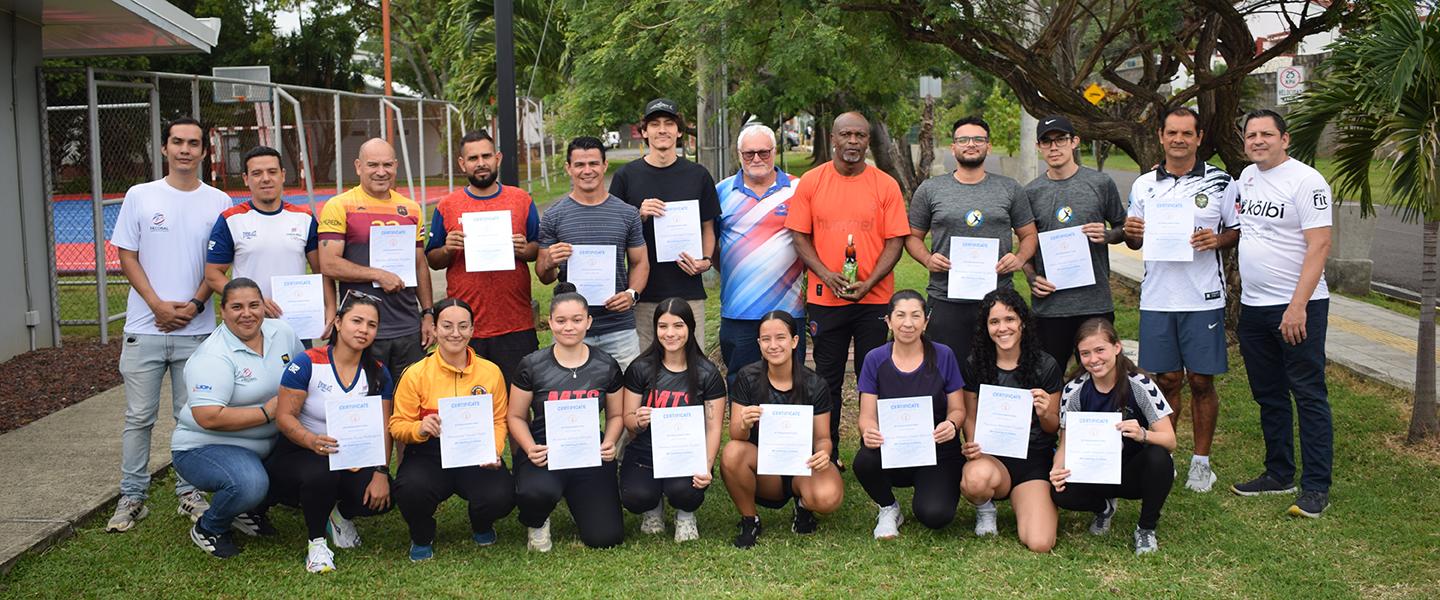
Two further IHF courses closed out in South and Central America this July, one in San José, Costa Rica, the other in Buenos Aires, Argentina, together adding 46 newly licensed coaches under the South and Central American Handball Confederation.
In San José, 16 candidates took part in Costa Rica's IHF D Licence course, eight men and eight women, taught in Spanish by Angolan lecturer Filipe Cruz between 6 and 10 July. All 16 passed. The five days combined theoretical instruction with practical, on-court coaching sessions, supported throughout by a demonstration team, with candidates working through both a written theoretical assessment and hands-on evaluation before being certified.
The group's starting level was rated normal going in, but attitude and engagement were rated good throughout, and homogeneity as excellent, with the lecturer's report describing candidates as showing genuine commitment to applying modern coaching methods in their own country afterward. Naomy Chavarria Cerdas stood out in particular, singled out in the report for how quickly she absorbed the course content.
In Buenos Aires, the IHF B Licence course ran from 9 to 17 July under IHF CCM Lecturer, Jorge Dueñas, and Argentine lecturer Eduardo Gabriel Gallardo, drawing a considerably larger group of 30 candidates, 26 men and four women. The course was international in scope, with participants travelling in from Chile, Colombia, Guatemala and Uruguay alongside the Argentine contingent. All 30 candidates passed.
Rather than sitting through lectures alone, participants delivered their own training sessions and presentations as part of the course, assessed by the teaching staff. Fernando Garcia, an experienced coach now working in the women's game after previously leading men's national teams at World Championship level, delivered training sessions and a presentation rated to a high standard.
Antonio Vazquez, a young coach working in youth categories, gave a strong individual presentation built around a training exercise. Nahuel Suberbie, an assistant coach with youth national teams who has worked at a South and Central American junior championship in Nicaragua, presented a session built around a seven-player game format. Leticia Brunati, primarily known for her work in beach handball as a world champion coach, was singled out as insightful throughout, with her on-court work and evaluations of participants rated to a very high standard.
The theoretical programme also featured two guest speakers brought in specifically to broaden its scope: Priscila Álvarez, a strength and conditioning specialist who worked with the Argentina national handball team between 2018 and 2024, and Daniel Elhelou, who worked with the Argentina men's national handball team over the same period, each contributing a distinct professional perspective alongside the core teaching team. Study material was distributed digitally, comprising IHF publications, the full set of speaker presentations, and additional material prepared on specific topics requested by the coaches themselves.
The lecturer's report recommends that host federations share participant numbers, ages, gender and skill level in advance of future courses to avoid a repeat.
Between the two courses, 46 coaches in Costa Rica and Argentina now hold an IHF licence, adding to the confederation's growing base of qualified coaching staff across the region.