

A new strategy which bears fruit: Germany’s influx of talent is built on more than a Plan B
23 Oct. 2026

After overturning a four-goal early in the second half deficit to beat Russia 34:31 in the semi-finals, Germany are one victory away from becoming the first world champions at the IHF Women’s Under-16 World Championship.
Coach Gino Smits pointed to a decisive defensive adjustment in the semi-final, but the progress of his team is also part of a wider development system that has delivered results across German women’s handball.
In Agadir, Germany were in trouble against Russia. Trailing 22:18 in the 37th minute of their semi-final at Morocco 2026, they looked exhausted. Russia had found a way through their defence, while Germany were struggling to contain the opposition’s key players.
But as it happened both at the W16 EHF European Open last year, when Germany lost in the preliminary round against Switzerland but went on to win the title, or at the 2026 IHF Women’s Junior World Championship, when the European side staged some fantastic comebacks to clinch the trophy, something clicked.
Here, the solution was to alter the defensive set-up, bringing backcourt players into the centre of the defence. The response was decisive: Germany regained control, completed a 34:31 comeback and booked their place in Saturday’s final against Hungary.
“We were very pleased that we managed to improve our defensive level, because that was the key,” Smits said after the match. “When your defence is stable, the goalkeeper also gets the opportunity to make those extra saves. That made an enormous difference for us.”
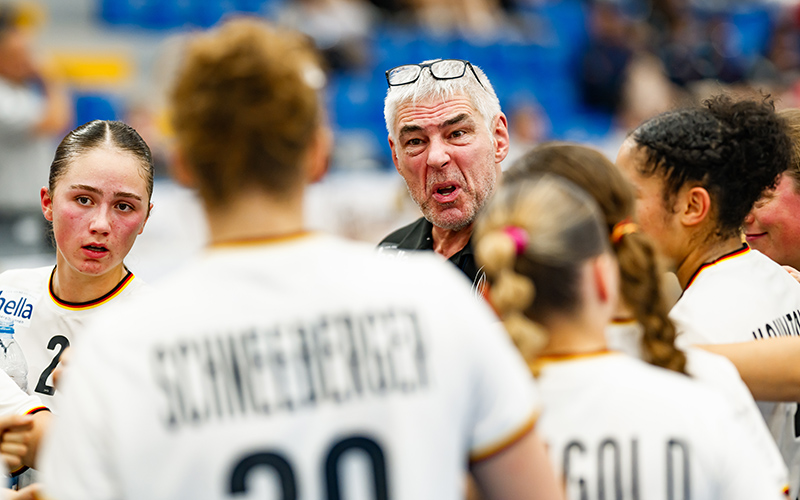
The change came after Germany had struggled with two-minute suspensions to Mariella Koumtoudji Tchatat and Emma Schneeberger, their line players who act as central defenders on that side of the ball. Smits opted for a different combination, using backcourt players in the middle to give the team a fresh defensive structure.
“We decided to go to Plan B and use players from the backcourt in those central defensive positions. That was the key to turning the game around,” he explained.
Germany still had to execute the plan. Russia had taken the lead after the break with a 6:2 run, but the German players gradually found their footing, applying the tactical instructions and putting more pressure on their opponents. Nora Lueg led the scoring with 10 goals, while Taya Nagel added eight.
“The girls fought for every ball, but they also understood what we were asking them to do and put those instructions into practice. We were able to adapt as the game developed. It was a very tough match, but I believe we deserved the win,” Smits said.
At Morocco 2026, Germany have the second best attack in the competition, with 176 goals, an average of 44 goals per match and 17 goals scored less than China, while their defence has conceded the lowest number of goals, 88, or an average of 22 per match, two less than China.

For Germany’s coach, the comeback was a demonstration of the habits he wants to see in his players and the ones that are the most sought after in Germany’s development pyramid: the ability to read the game, recognise what needs to change and take responsibility for carrying out a new plan under pressure.
And the progress symbolises the work put in by Germany, which has produced results at senior, junior and youth level in a remarkably short period.
The senior women’s team reached the final of the 2025 IHF Women’s World Championship, winning silver after a 20:23 loss in the final against Norway. But on the way there, they dispatched of Brazil in the quarter-finals and France, the silver medallists in 2021 and the world champions in 2023, securing the best achievement in 30 years in the competition.
In July 2026, Germany’s junior team went one step further, defeating Denmark 33:26 to win the IHF Women’s Junior World Championship in China. The current Under-16 side also lifted the Women’s 16 European Open title in Göteborg, beating Hungary 29:17 in the final.
Those achievements might belong to different squads and generations, but together they illustrate the breadth of Germany’s development programme. And for everything to click, multiple things need to happen at the same time.
Assembling a talented team for one tournament is a challenge, but the bigger one is to identify players early, develop them over several years and prepare them to be ready when they make the step towards senior international handball.
According to Smits, the German Handball Federation’s pathway links clubs and schools with regional associations, talent identification, youth leagues, performance centres and national-team programmes.
Its structured selection process for girls begins at around 14, with further assessments and training opportunities narrowing the pool while allowing coaches to follow individual development. Players continue to compete with their clubs while progressing through the national age-group system towards the senior team.
For Smits, that long-term approach has been central to the work with Germany’s young players.
But the main change for the process and how it approached girls’ development came around six years ago, with the aim of preparing them earlier and more effectively for the highest level.
“We changed the way we look at developing the girls, and we started working in this direction six years ago. We can now see that more girls are becoming interested in the senior national team at an earlier age. I believe we made a very good decision, and I hope we can continue building on it,” he said.
But what’s the prototype of player Germany look for?
Of the utmost importance is the right mindset, an understanding of the game and the capacity to make decisions independently. Those qualities become especially important when a match moves away from the original plan, as Germany’s semi-final against Russia showed.
“For me, the first thing is having the right mindset for high-level sport. Players also need to read the game. If they understand what is happening in attack, they can learn to read the game in defence as well,” he said.
“That is why we do not simply wait for the opposition to play. We try to put pressure on them, force technical mistakes, make it harder for them to shoot and win the ball back. That mentality is important in the way we develop our young players.”
The next test is the final against Hungary and the chance for a double at this level. One year ago, Germany Under-17 men’s team won the world title in Morocco, with a dramatic final against Egypt, decided in overtime.
This time around, Hungary will provide another demanding test in the final. The two sides already met in July’s Women’s 16 European Open final, where Germany won 29:17 to claim their first title in the competition.
“We are going to try and win it, of course,” concludes Smits.