

Look Back: Buenos Aires 2018 Youth Olympic Games Beach Handball - Women
27 Oct. 2026
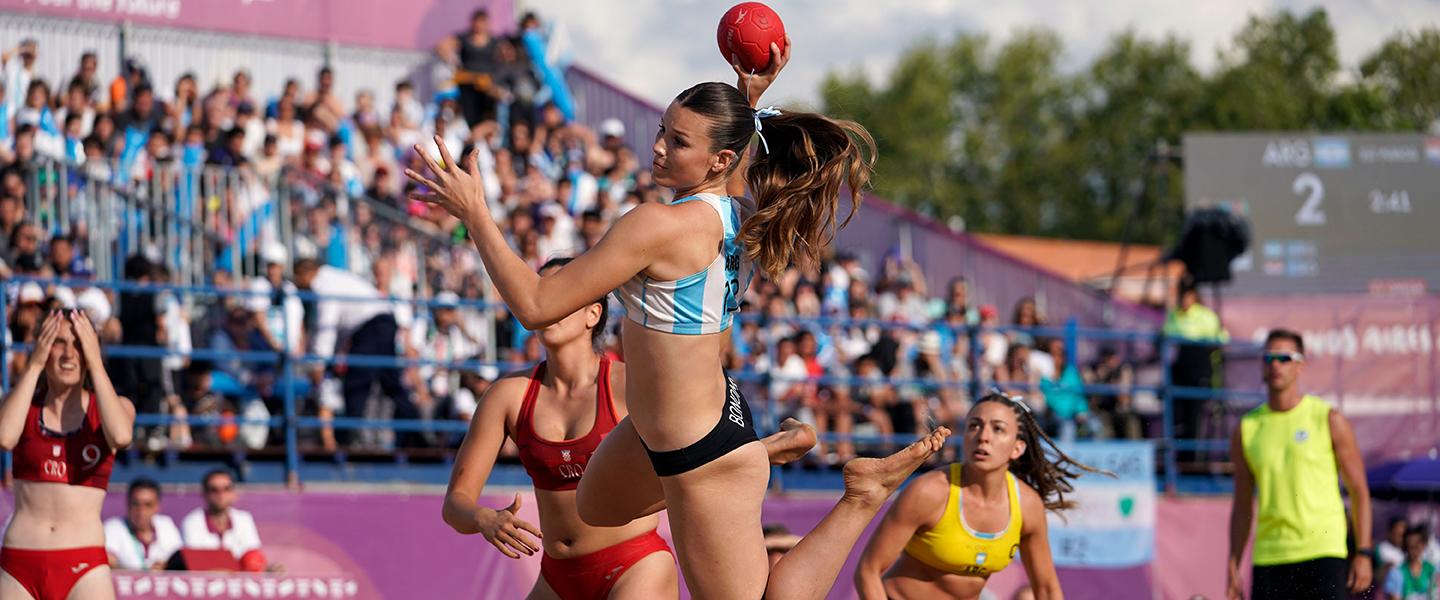
With the 2026 Youth Olympic Games, featuring beach handball, throwing off in Dakar, Senegal in November, IHF.info takes a look at the last edition, held eight years ago in Buenos Aires, Argentina.
The event: The third edition of the Summer Youth Olympic Games, under the slogan ‘Feel the Future’, took place in Buenos Aires, Argentina from 6 to 19 October 2018 and featured boys and girls beach handball competitions at Parque Sarmiento from 8 to 13 October.
What was new: Everything. Buenos Aires 2018 was the first time beach handball was included at an Olympic Games after replacing indoor handball, which had been present at the debut Summer Youth Olympic Games in 2010 (Singapore) and second edition at Nanjing (PR China) in 2014.
The competition: 12 women’s teams were split into two preliminary groups of six teams each. After each team had played each other in their respective group, the top three in each group went through to a main round group of six while the bottom three teams in each preliminary group dropped into a consolation round.
The top four teams in the main round group qualified directly through to the semi-finals and subsequent medal matches, while the remaining two teams in the main round and those in the consolation round played in the 5-6, 7-8, 9-10 and 11-12 placement round games.
In total, 56 games were played on three courts across six matchdays.
Who won: Host nation Argentina made history, taking the first-ever women’s beach handball Olympic gold medal, defeating Croatia 2-0 (14:10, 18:16) in the final in front of a capacity crowd at Parque Sarmiento, with fans queuing outside many hours before the gates opened. Hungary beat Netherlands for bronze.
Review: Two months before the start of Buenos Aires 2018, IHF Beach Handball Working Group Chairman Giampiero Masi was at the Argentine Olympic Committee headquarters in Buenos Aires to conduct the draw for both the men’s and women’s beach handball competitions.
12 teams from five continents were drawn, including Croatia, Hungary, Netherlands, Russian Federation and Turkey from Europe, hosts Argentina along with Paraguay and Venezuela from South America, Chinese Taipei and Hong Kong from Asia, Mauritius from Africa and American Samoa from Oceania
“We are all very excited at the IHF to show how attractive beach handball is on a global scale and I'm sure the participants will experience the very best conditions in Buenos Aires for showing their very best,” said Masi after the draw.
Going into Buenos Aires 2018, Hungary’s women were clear favourites for gold after winning the debut IHF Women’s U17 Beach Handball World Championship in Mauritius the previous year and following it up with the 2018 EHF EURO U18 title in Montenegro a few months before the Youth Olympic Games.
However, with their bronze medal gained in Mauritius, Argentina – with the home crowd behind them and guaranteed entry as hosts into the tournament for many years previously – were ready to challenge the favourites tag, complete with coach Leticia Brunati working with the legendary Brazil coach Antonio Guerra Peixe in the preparation period.
The remaining medallist from Mauritius – Netherlands – could also not be discounted. They had won the 2016 Women’s U16 EHF EURO and then won the U17 continental title the following year, with the global silver added to it.
Ahead of the opening game in Buenos Aires, beach handball was front and centre at an impressive opening ceremony held around the Buenos Aires Obelisk, in the middle of the Argentina capital. In front of an estimated 200,000 people, IHF referee and Buenos Aires native Lorena Mac Coll undertook the Olympic oath on behalf of all officials and referees on the main stage.
On the sand, the opening day of the beach handball competitions – Monday 8 October – saw Netherlands’ goalkeeper Lisanne Bakker etch her name in history as after just 43 seconds she scored the first-ever beach handball points in an Olympic Games.
The bulk of the 56 competition games took place in the preliminary round, with 30 games played across the opening three days.
The opening day of action saw Chinese Taipei upset the Russian Federation with a shoot-out win as host nation Argentina, led by Gisella Bonomi, won both of their games in a full central court, a much-needed relief of the pressure which comes as the home side.
Day two saw Argentina, along with Netherlands and Hungary, maintain their perfect record, moving to four wins out of four to confirm their main round places, along with Chinese Taipei and Croatia, while Russia, American Samoa, Mauritius, Turkey and Hong Kong all moved into the consolation round, with the South American derby between Paraguay and Venezuela deciding the final qualification.
By the third matchday, the power of beach handball had been realised with the national media in Argentina describing it as the “revelation” sport of the Youth Olympic Games as Paraguay just about did enough to squeeze past Venezuela, to win 2:1 via a 7:6 shoot-out to take the final main round spot. Hungary ended the preliminary round campaign with the most points scored (228).
With maximum points taken into the main round, it was no surprise that Hungary and the Netherlands moved into the semi-finals on the first day of main round action after two games. They were joined by the host nation in the last four after they won both of their games via shoot-out, including a defeat of Hungary – handing the European side their first loss.
These results, combined with the Netherlands winning both of their games via shoot-out too, ensured that Croatia, Chinese Taipei and Venezuela had one semi-final space to fight for between them going into the third and final match of the main round on day two, with Croatia’s win against Paraguay ensuring they booked their final four spot.
Hungary beat Netherlands via shoot-out to hand the Dutch their first loss, but with those two and Argentina all on eight points each, the main round placings went to a mini-group to decide their rankings, with Netherlands top, Hungary second and Argentina third.
The 7-12 placement games were settled too with Russia defeating Venezuela for seventh, Turkey seeing off Hong Kong for ninth and American Samoa beating Mauritius for 11th.
The sixth and final match day was intense with semi-finals played in the morning session and the medal matches played in the afternoon/early evening session.
The first semi-final pitted Argentina against Hungary with the home side ensuring a medal thanks to a 2-1 (20:18, 12:16, SO 7:6) victory. In the shoot-out, the Hungarians missed their first shot after Dorottya Gajdos was penalised for barging the goalkeeper, but the host nation could not capitalise as Zoe Turnes saw her subsequent shot saved by the Netherlands.
At 4:4, Lucila Balsas then saw her shot saved and the home crowd started to worry about their team grabbing a place in the final, but in more drama, pivot Rebeka Benzsay missed her shot. It then went to 6:6 after five shots and a second, sudden-death round.
As the home fans prepared for more shots, Hungary's Csenge Braun missed the opportunity to put the pressure on their opponents and, presented with just a single point to take the win, Caterina Bendetti Gorga sunk home and put her side in the final.
The second semi-final was clearer, with Croatia taking a surprising 2:0 victory over Netherlands, gaining revenge for their main round loss at the 2017 IHF Women's U17 Beach Handball World Championship.
"It was a tough game but we were very strong in our heads," said Croatian specialist Ana Malec to IHF.info. "We knew it was going to be hard, but we fought very strong. We knew we could do it and we did it. We have never beaten Netherlands, here, we only won one set in our previous game, and now it's 2:0."
“This has been a global moment for us,” added Giampiero Masi to IHF.info ahead of the finals. “To be here at the Youth Olympic Games is to now be recognised worldwide. This is not just a moment in a life; it’s something that has to be the base for our job for the future.”
World Champions Hungary recovered the quickest after the disappointment of their morning loss to easily overcome Netherlands 2:0 (16:13, 20:18) in the bronze medal match, while the very last game of the whole beach handball competition at Buenos Aires 2018 saw Argentina take on Croatia for gold.
With a packed central court watching – including IOC President Dr. Thomas Bach – and hundreds sitting on the sand on courts two and three viewing on big screens, the atmosphere was electric inside Sarmiento Park, which had been closed to spectators as it was full.
And the host nation closed it in the perfect way, winning 2:0 (14:10, 18:16) for gold and end the debut of the sport in the Olympics in a fairytale way. In the end, Leticia Brunati's side were never really troubled as the European side had trouble breaking through the South American defence, ending with just a 52% success rate in front of goal, compared to 73% from Argentina.
“This is the result of dedication, effort, humility, and courage. I’m very emotional because they gave so much to get to this day,” said Brunati. “We thought we’d reach a semi-final, with two or three matches lost, but we gained confidence, we got a break in the main round against Hungary, and we realised that we had to go for it all.”
“It still hasn't fully sunk in,” said Argentina’s Fiorella Corimberto. “We've achieved what we've been dreaming of for many years.”
For 2018 Youth Olympic Games women’s beach handball quotes, statistics, photos, match reviews and a whole lot more, visit the mini-site HERE.
Buenos Aires 2018 Youth Olympic Games Beach Handball - Women
Final Ranking
1 Argentina (Gold)
2 Croatia (Silver)
3 Hungary (Bronze)
4 Netherlands
5 Paraguay
6 Chinese Taipei
7 Russian Federation
8 Venezuela
9 Turkey
10 Hong Kong, China
11 American Samoa
12 Mauritius
What happened next: A number of players graduated to their senior teams and played at the ANOC World Beach Games 2019 as well as subsequent continental and global events. Brunati, Bonomi and a number of the gold medal-winning Argentina side went on to hold all possible titles as a senior side having won their continental championship (2026), The World Games (2025) and World Championship (2026).
Photo credit: International Olympic Committee / Ubaid Rutar