

Italy’s new era under Bob Hanning: "Victory loves preparation"
01 Jun. 2026
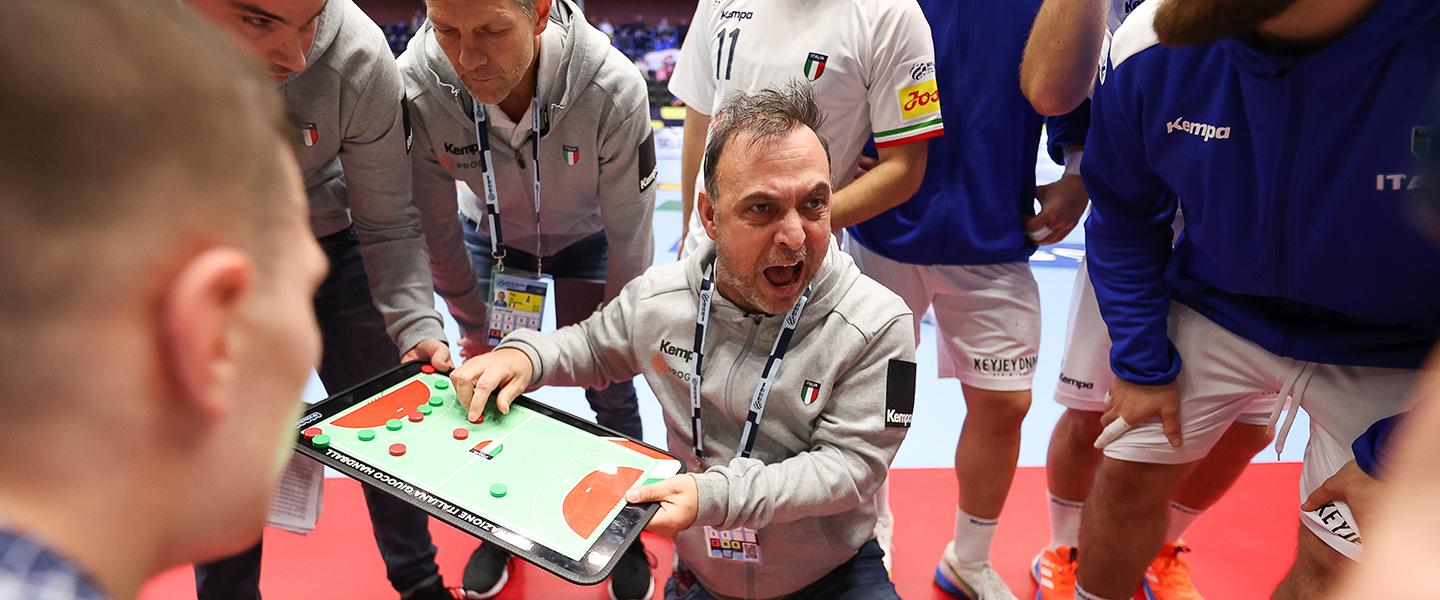
Only days after Italy concluded its campaign at the 2025 IHF Men’s World Championship by finishing 16th, Italian Handball Federation president Stefano Podini announced in Oslo that Bob Hanning would take over as the new coach of the European side.
A highly experienced handball figure, Hanning previously served as vice-president of the German Handball Federation, worked as an assistant to Heiner Brand at the Sydney 2000 Olympic Games, and most recently combined the roles of manager and youth coach at Füchse Berlin, where he helped guide the club to the Bundesliga title in the 2024/25 season.
His appointment may have surprised some, particularly with Trillini having led Italy’s revival from 2017 to 2025 and helping the team qualify for a World Championship for the first time since 1998, but it also marked a natural next step in the European team’s progression on the global handball stage. And now, with Hanning at the helm, Italy will return to the 2027 IHF Men's World Championship, the first time in history with the European team making back-to-back appearances in the world handball flagship competition.
“First of all, there was good development in the federation in recent years, also before I joined them. Secondly, the president of Italy called me and said we need a new way for Italy to grow and make the next steps,” says Hanning for ihf.info.
“So it was not only about finding a coach, it was also about finding, I would say, a team manager like me. Someone who knows how clubs like Hamburg or Berlin grew over the last 20 years. And for my part, I spent eight years with the German national team, also as vice president, helping to build something up. That was the reason why he asked me to come to Italy, and that was also the reason why I said yes, because I truly believed it was the best decision for the Italian federation to bring me in, as everything they needed was something I could offer.”
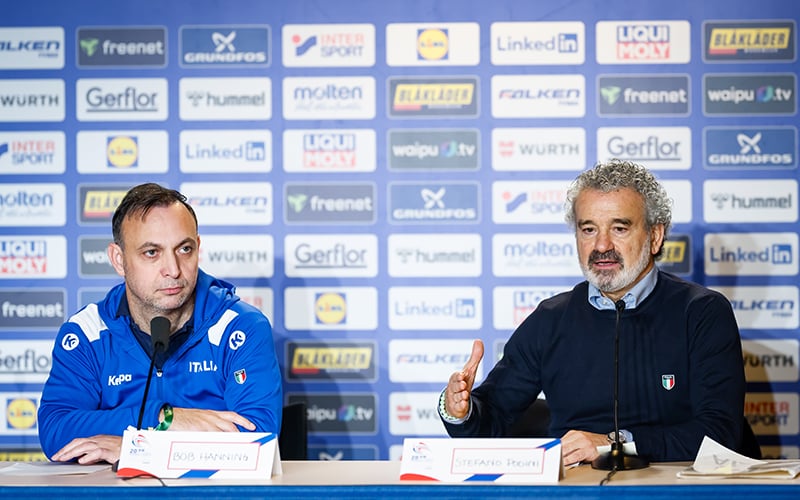
There have been instances of teams which have appeared at a World Championship edition and then went into oblivion. But Hanning’s plan was clear: to develop a good team, which would become a staple at major international events.
And Italy had some ingredients there, especially with some key players, like goalkeeper Domenico Ebner or line player Andrea Parisini featuring for years in strong leagues like the German Bundesliga or French Ligue Nationale de Handball.
But would Italy stay strong?
The answer was a resounding yes, with Hanning leading the team at the Men’s EHF EURO 2026, where they lost against Iceland and Hungary, but won against Poland, finishing 18th.
In turn, that meant a doubleheader against Switzerland awaited them in the Qualification Europe – Phase 3 for the 2027 IHF Men’s World Championship, with Italy relishing the prospect of producing another upset against a team which is, at least on paper, at a later stage in their development process.
“The biggest problem is always the structure - making people understand that small things also have to work. Not only the team, but the team around the team: the staff, the federation, bringing everyone to the same level and working toward the same goals. So that everyone says: "OK, we are aligned and we go with him for our aims." I had worked within the federation in Germany, and now I am working for the Italian federation. That is the same approach I also apply at Füchse Berlin. So many small things were not working - players had to worry about tickets, about kit,” says Hanning.
“We trained in an arena preparing for a championship at minus three degrees. I could tell you a hundred stories like that.”
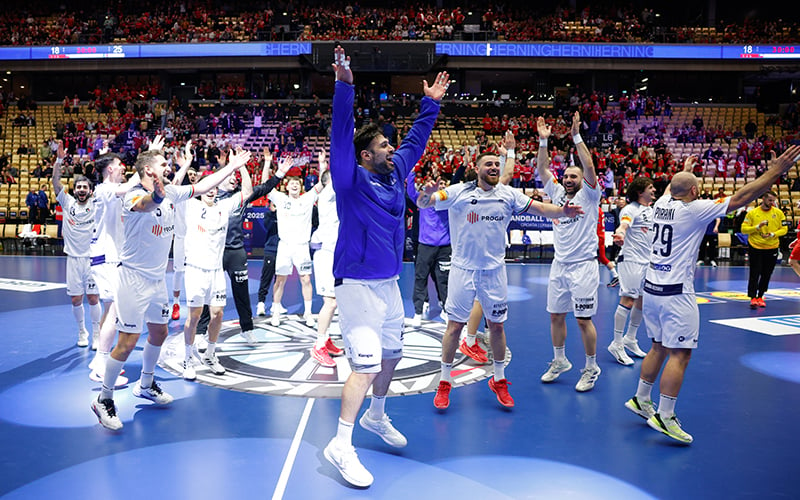
Still, with Hanning’s experience, the FIGH’s blueprint of nurturing a new age for Italy’s handball and the players buying in into a new system, the things slowly started to get better and better.
A small glance at Italy’s roster for the EHF EURO 2026 painted a clear picture: eight players featured in Germany, three in France, three in Spain and one each in Romania and Austria. Only three of the players in the roster were playing club handball in Italy.
And that experience in strong leagues proved invaluable.
“My job is to - basically you are a manager, not only a coach - to show them that if the player feels comfortable, they will give everything on the court. They don't have to think about so many other things. Their mind should only be focused on the match and on training. That's it. And the respect comes back from the other side. If you can only think about sport, everything becomes much easier,” adds Hanning.
“In Italy we have someone who protects them and gives them everything they need. And we have a really excellent president in Stefano Podini. He is also the owner of large companies, and he understands what it takes to do things this way. I always say - and I can say it in English – “Victory loves preparation.”
Take, for instance, Domenico Ebner, who was born in Freiburg, close to the Italo-French-Swiss border, and has played his entire career in Germany. Or Leo Prantner, who is now featuring at Hanning’s Füchse Berlin. Three other players are signed for VfL Potsdam, Füchse’s feeder club.
Italy’s average age for the EHF EURO 2026 squad was 26.8 years old, proving that the team also has a future on the medium term.
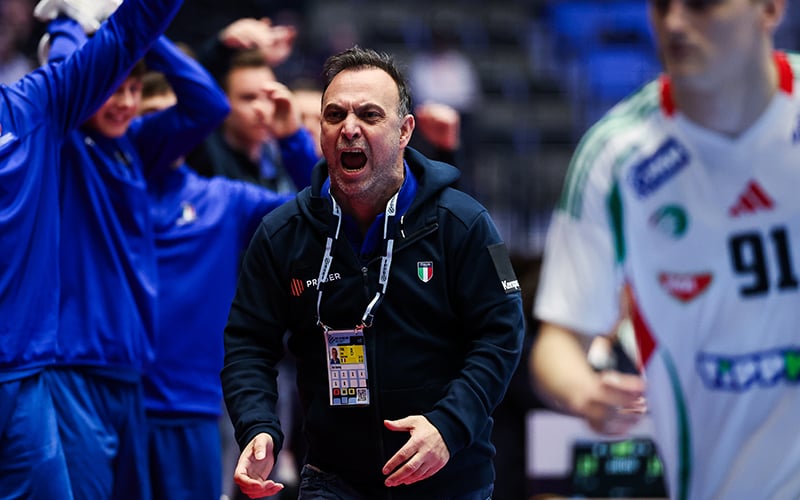
“We have to bring our league to the next level. That will also be a fight. Sometimes in Italy, I am not sure they really want to change, but the most important thing is what they need to change. To become more professional, to bring the league up. If you want to help Italy become better, you have to help the league take that next step. For example, I took Marco Mangon, Bulzamini and Sontacchi to Germany, just to show them what is possible. I also brought the national team to Berlin for one week of preparation, to see how things work at a higher level. As a result, Marco got an offer from Stuttgart. I said: "OK, you can go to Stuttgart," says Hanning.
But what’s the blueprint for creating new players and providing a pipeline for the senior national team?
“I go to watch the U18 and U20 teams. They have a gathering in Chieti, I go there to look at the players. The federation is also now working to do better in Italy. But that is their job. I cannot take responsibility for the development of the young players. I don't have the time to go to Italy and change everything there. I can only tell them what needs to change and support them in working toward it — new groups, new structures,” says Italy’s coach.
Yet Hanning is adamant that change have to come from within and the needs of players aged 14 to 20 years old are totally different than the senior ones. Therefore, Hanning will not need ready-made players for the senior team, rather than ones who are constantly developing.
“I have never liked that approach to copy everything from the senior team, even though I have always heard about it. I think players between 16 and 18 need completely different things than a national team. They can look at what we do - for example, we play 3-3 defence. They are also now looking at being a little more open in defence. Against Switzerland we played 6-0, combined with the 3-3. But I believe the individual development of each player in the youth teams is more important than replicating our exact system,” adds Hanning.
However, the coach says he believes 200% in his players and while changes were made in his tenure, everything is still centred on the main actors, who have also adapted to a new style and a new mentality.
“Simone Mengon has a huge influence, he has a huge merit for his leadership role. He is my right-hand man for this team. I speak to Bulzamini often — he plays in Potsdam and is key to our defence. I trust them, and they know they can trust me in any moment, in any minute, in any situation. We have a really, really good relationship. I give them a lot of freedom, because that is a little bit the Italian way. I do not want to change everything into the German style. I let them keep the Italian spirit, but with a somewhat more professional approach to the work,” adds Hanning.
And this is how Italy managed to deliver a pitch perfect performance in the doubleheader against Switzerland, especially in the second leg of the qualification play-off, which was played in Italy.
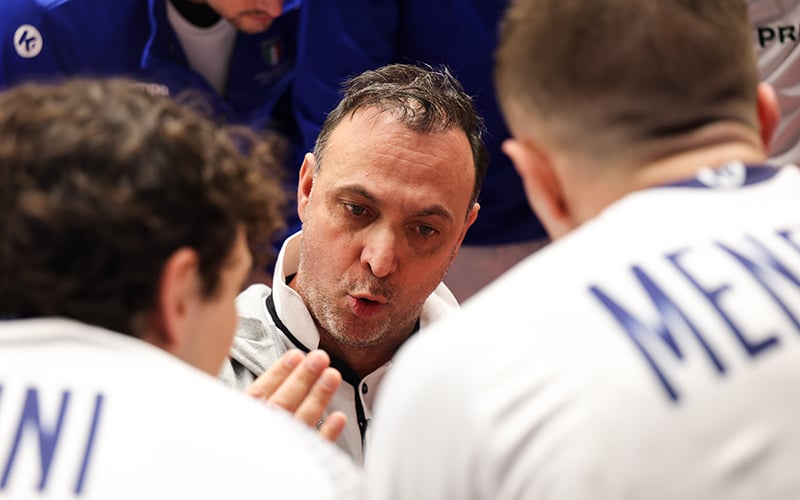
In the first leg, Italy lost by three goals, 29:32, after leading at the break, 17:16. Before the second match, in Faenza, Hanning sounded the Italian fans, telling them that their support is two-goals worth. “Help us throughout the game, and we’ll make sure we score the other goals which will take us to the World Championship,” said Hanning.
At half-time, Italy were up by eight goals, 20:12. They eventually won by seven, 38:31, but they still secured a 67:63 aggregate win to clinch their third berth in history for the IHF Men’s World Championship.
“We worked very hard on our mentality to approach these games in a different way, not only to say it's nice to play against a good team, but to go as a good team against a good team. Before, we said: "OK, we do it because we are Italy." Now we do it because we are Italy and we feel like them. The Italian people have so much passion — we go all in, and this was the result,” says Hanning.
Hosts Germany have already placed Italy in Group B in Stuttgart. Depending on the outcome of the remaining pot allocations, Italy could face either Egypt or Argentina from Pot 1, and a favourable draw would leave the European side in a strong position to win the group.
For now, Hanning does not think about the future. But he tells a short story about what going all in an visualising a result means for him and for Italy.
“We were in the arena 24 hours before our game. I said to the guys: "Close your eyes and think about what will happen in 24 hours. Make your own picture — only your picture of what will happen in this arena after the game." And after we won, I walked in wearing my Dolce & Gabbana shirt with the Italy symbol. I said: "I bought this shirt four months ago. I bought it to come to you in this moment, to tell you what we have achieved." That was also the picture I had in my head — standing in the middle of the court. And that is the way to win,” says Hanning.
“We go into every game to win. I know we can lose against Belgium — it would not be a surprise. We are not at 100% yet. At 90%, we are not good enough to beat the USA. At 80%, we can lose against any team. That we have to know. I also spoke to the players about it: "You can bring your family to the hotel the day before the game, like you always do. Or we can say: nobody comes. We focus only on winning this game and making history. It is up to you. It is not my decision — it is yours.”
Photo credit: EHF EURO 2026 pictures - EHF / kolektiff / Damir Sencar