

IHF coaching education advances through four courses across Africa
07 Oct. 2026
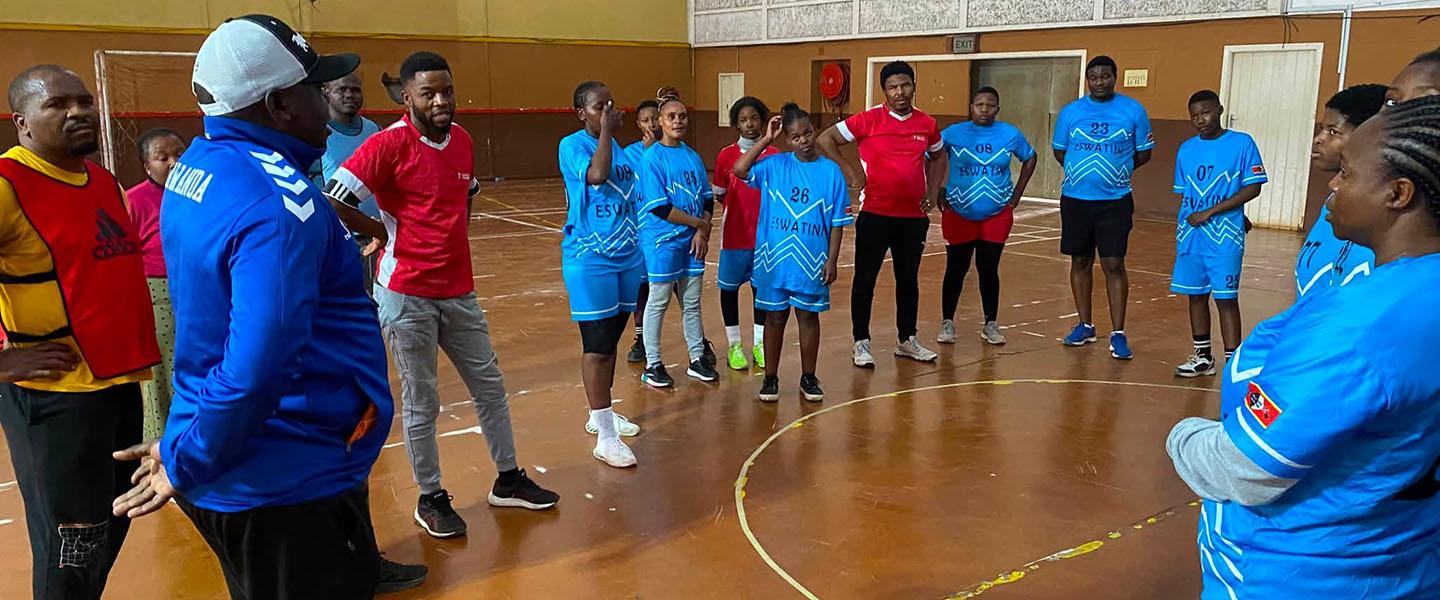
Four IHF Coaching Education courses held in Algeria, Egypt, Seychelles and Eswatini during July and August gave coaches at different stages of the IHF Licence pathway the opportunity to work through theory, practical sessions and formal assessments.
In Algiers, the IHF B Licence course brought together 36 coaches from Algeria and Tunisia between 23 and 30 July. Led by IHF Experts Dr Nahla Boudhina and Dr Souhail Hermassi, with the support of CAHB representative Kouassi Kévin Konan, the programme combined theoretical teaching with practical and pedagogical activities. Participants worked in groups, delivered presentations and took part in discussions and professional debates, using the sessions to examine different coaching situations and exchange experience from their work in handball.
The course covered technical, tactical, physical and pedagogical aspects of coaching, with participants expected to apply the principles discussed during the practical work.
The practical and interactive nature of the Algiers course was reflected in the participants’ assessment. Of the 36 coaches who attended, 32 completed the requirements for the IHF B Licence.
The next course took place in Cairo, where 28 Egyptian coaches attended the IHF C Licence programme from 5 to 12 August. Led by IHF CCM Lecturer Mohamed Khaled Hammouda, the course was conducted in English and Arabic and included both classroom work and practical training.
The practical element made use of a performance team, which was available for two days, while the lecturer also relied on the participants themselves for parts of the training. The course included a formal theoretical assessment, with 27 of the 28 participants successfully completing the requirements for the licence.
A notable feature of the Cairo group was its level of existing experience. Seven coaches were singled out for their potential, with the first four described as former international players who had won continental titles and competed at World Championships. Several were already involved in coaching national teams, while the group as a whole demonstrated a strong technical background and a high level of familiarity with analysis software and sports technologies.
In Victoria, Seychelles, the IHF C Licence course ran from 3 to 10 August under Swedish IHF Lecturer Ola Lindgren. Ten coaches took part, including eight men and two women, representing Comoros and Seychelles, and all ten completed the course successfully.
Here, practical coaching work was carried out with a younger demonstration group, with girls aged 15 to 18 and boys aged 18 to 20 involved in the sessions. The practical sessions required the coaches to work directly with young players and apply the material covered during the course on court.
The course in Mbabane, Eswatini, completed the group of programmes, with 21 coaches attending the IHF D Licence course from 10 to 14 August. Led by IHF Lecturer Anaclet Bagirishya of Rwanda, the course combined classroom learning with on-court work aimed at introducing and developing fundamental coaching competencies. In the practical sessions, participants worked through technical drills, tactical exercises and game-based training situations, using the court work to apply the principles introduced during the theoretical sessions
The progression of the Eswatini course was also reflected in the assessment process. All 21 participants ultimately completed the course successfully.
Across the four courses, the emphasis remained on putting coaching knowledge into use. In Algiers, coaches challenged one another through presentations, group work and analysis of coaching situations; in Cairo, experienced former internationals worked through the C Licence programme while drawing on their existing technical background; in Seychelles, coaches practised with a young demonstration group; and in Eswatini, theoretical concepts were carried directly into technical, tactical and game-based exercises on court. Four different courses, four different starting points, with the same requirement at their centre: coaches had to demonstrate that they could apply what they had learned.