

IHF coaching courses continue their momentum in Peru
17 Jul. 2026
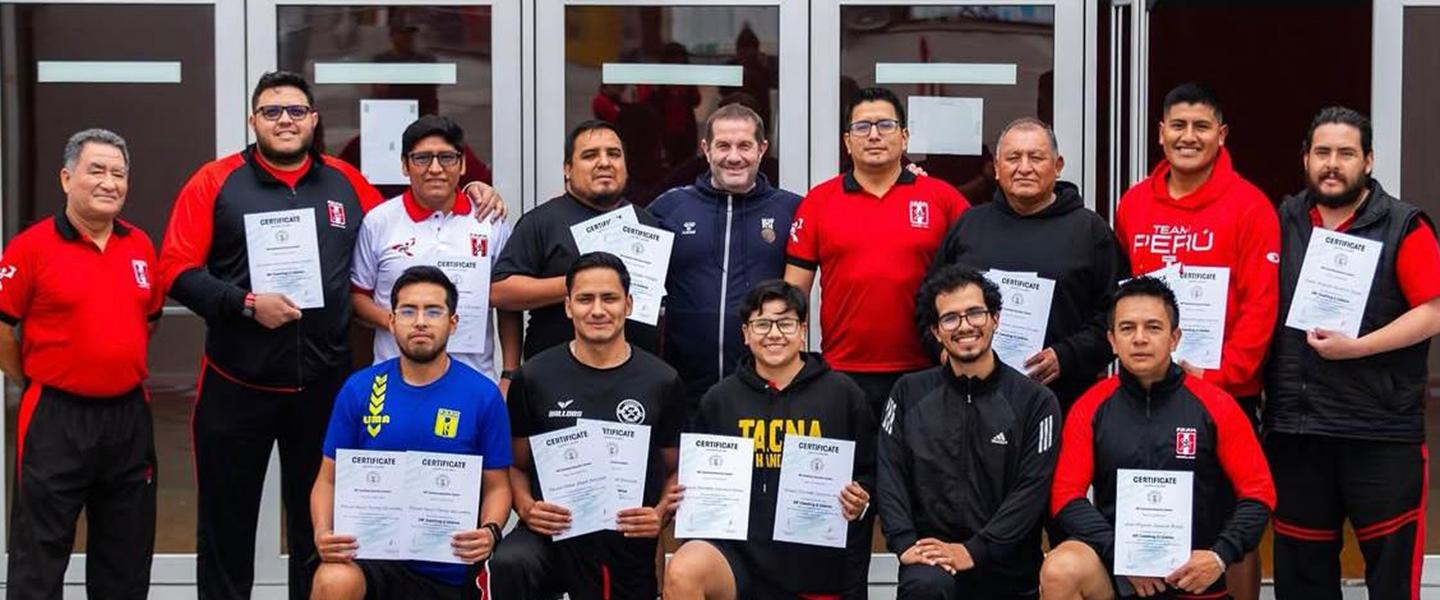
Following the success of its recent C-Licence and D-Licence courses in Chile and Colombia, the IHF's coaching education programme continued its strong presence in the Americas with two further courses held in Lima, Peru.
The IHF C-Licence Coaching Course took place in Lima from 22 June to 5 July 2026, gathering 14 participants, 13 men and one woman, all from Peru. Of those, 13 successfully completed the course and were awarded the IHF C-Licence.
The course, led by IHF CCM Lecturer Eduardo Gallardo, was held at the facilities of the Peruvian Olympic Committee.
The Lima course followed a structured balance between theory and practice, designed to give participants both the conceptual grounding and the hands-on coaching experience needed for the IHF C-Licence. Theoretical sessions were delivered at the Peruvian Olympic Committee's dedicated classroom, equipped with sound systems, a whiteboard and four televisions, allowing for clear delivery of tactical, methodological and sports-science content across the two-week programme.
The practical component took place daily at the Peruvian Sports Institute gymnasium, a venue of true elite standard, having hosted the Lima 2019 Pan American Games and set to do so again in 2027. Coaches trained on a professional floating parquet floor with a rubber surface, using official-size goals and nets in excellent condition, offering participants a training environment matching what they might encounter at continental or world-level competition.
Training materials were carefully prepared to support the practical sessions: the IHF supplied resin-free handballs across multiple sizes, with 20 balls of each size made available according to the number of players training at any given time. Cones, barriers and vests were also provided in the quantities required.
A key part of the practical learning process involved demonstration teams, made up of local youth and junior players, who worked directly with the coaches throughout the sessions. This gave participants real opportunities to apply theoretical concepts in live training environments - though it also introduced an authentic coaching challenge, as the demonstration players' performance varied from day to day, requiring the coaches to continually adapt their training plans and session structures on the spot. Rather than being a drawback, this variability became a valuable lesson in itself: coaches were pushed to build flexibility and responsiveness into their coaching approach, a skill considered essential at any level of the sport.
The course concluded with a theoretical examination, testing participants on the material covered throughout the programme, alongside continuous practical assessment during training sessions. Of the 14 participants, 13 successfully passed and were awarded the IHF C-Licence, reflecting both the strength of the group and the effectiveness of the course's dual theory-practice methodology.
Course feedback highlighted a strong, inquisitive group dynamic, with Jhonatthan Ibarra, coach of the Peruvian women's national team, singled out as a standout participant for his proactive contributions and strong practical evaluation.
The opening ceremony was attended by Sergio Ludeña, President of the Peruvian Sports Institute, and Alex Diaz Matos, while the closing ceremony welcomed Renzo Manyari, President of the Peruvian Olympic Committee. The course received strong media coverage across the social channels of the Peruvian Handball Federation, the Peruvian Olympic Committee and the IPD.