

IHF C-Licence courses in Niamey and Hammamet add nearly 60 coaches to CAHB's roster
13 Aug. 2026
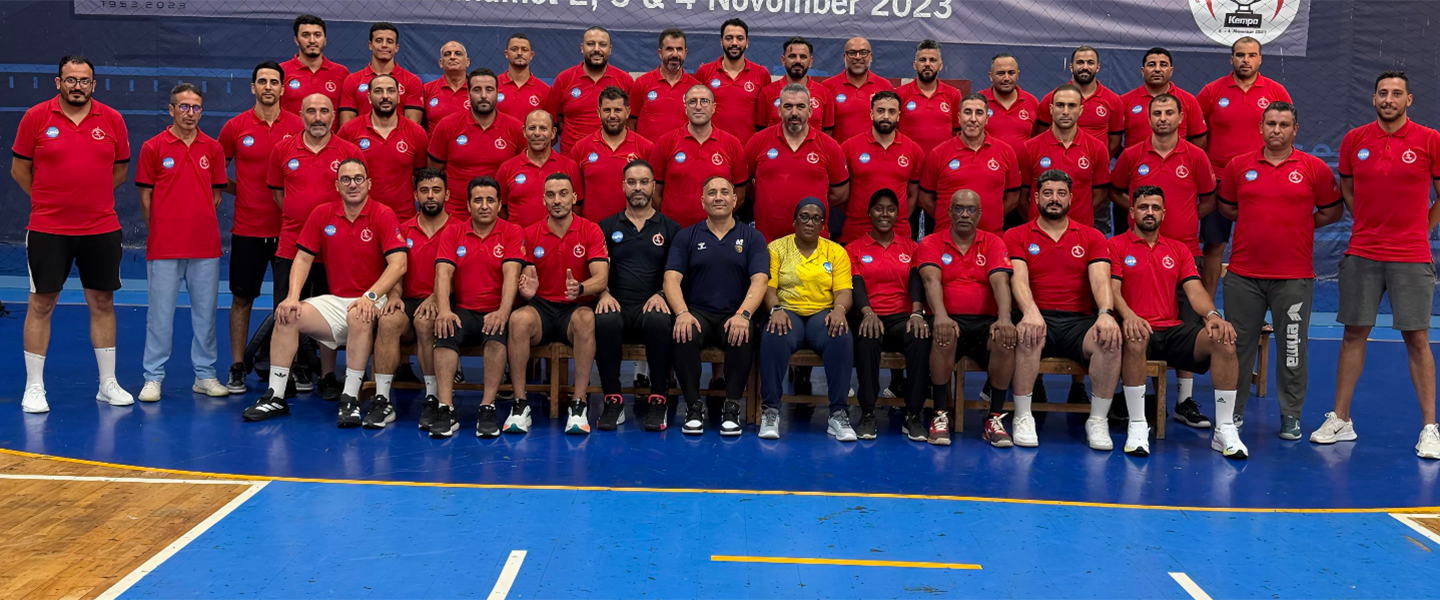
Within days of each other this summer, two IHF C Licence courses closed out on opposite ends of the African continent's coaching calendar, one in Niamey, Niger, the other in the seaside town of Hammamet, Tunisia. The two courses handed out, between them, licences to 56 new coaches under the African Handball Confederation.
In Niamey, 20 candidates signed up for Niger's course, 15 men and five women, taught in French by Egyptian lecturer Mohamed Khaled Hammouda, with 19 passing the course. Most had already come through a study session for the D Licence in 2025, which gave the group a shared starting point that lecturers rated as good, with attitude and interest also marked good throughout. Each candidate had to build a final project around a training theme of their own choosing, presented on PowerPoint and illustrated with footage they filmed themselves during the practical sessions.
Two names stood out in Hammouda's report: Issoufou Imrane Maiga Ismael and Rachid Adamou were singled out for their potential, alongside Safiatou Diallo and Rakiatou Issaka among the group's female candidates.
Roughly a thousand kilometres, Hammamet hosted a course on a different scale entirely. Tunisian lecturer Souhail Hermassi worked through the syllabus with 37 candidates, 36 men and one woman, over eight days from 13 to 20 July. All 37 passed.
One candidate finished well clear of the rest: Idriss Drissi, a former national team player with a sport science degree, posted the highest overall score in the group and topped the final rankings. The teaching load was shared with Hamdi Snoussi, an IHF/CAHB multiplier, with Kadidjatou Diarrassouba, head of CAHB's Beach and Wheelchair Handball division, supervising on the confederation's behalf.
The eight days mixed interactive lectures with group discussions, video analysis, workshops and practical coaching sessions, aimed at getting candidates trading experience with each other rather than just absorbing material from the front of the room. A demonstration team was on hand for the practical work and the equipment list stretched well beyond a ball and a whistle: laptops, a projector, flip charts, cones, markers, bibs, tactical boards and a full set of IHF-standard match balls, alongside rule books in English with explanations offered in candidates' own languages wherever the theory needed translating.
The curriculum itself ran wide rather than narrow, covering long-term player development, training methodology, coaching pedagogy, technical fundamentals, attacking and defensive tactics, talent development and the Laws of the Game.
Candidates were judged on two fronts rather than one - a set of practical coaching assessments where each had to actually run a session under evaluation, and a separate final assessment that produced the overall rankings, the one Drissi topped. Hermassi's report puts the full syllabus, theoretical and practical alike, at 100% delivered against the IHF standard, with all 37 candidates clearing the bar.
In total, 56 coaches secured their IHF C-Licence after these courses, underlining the commitment of education put by the IHF on all continents.