

‘I don’t believe in limits’
04 Dec. 2025
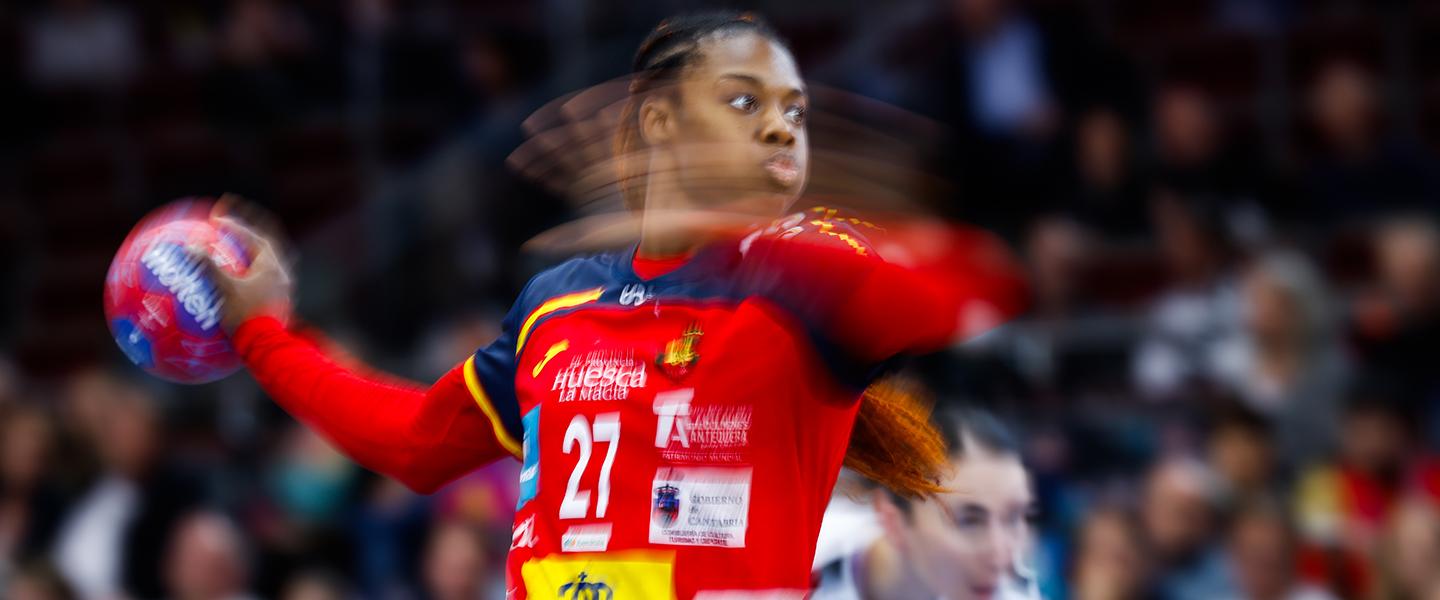
In handball, statistics are everywhere: goals scored, saves made, percentage of saves. They all tell a story.
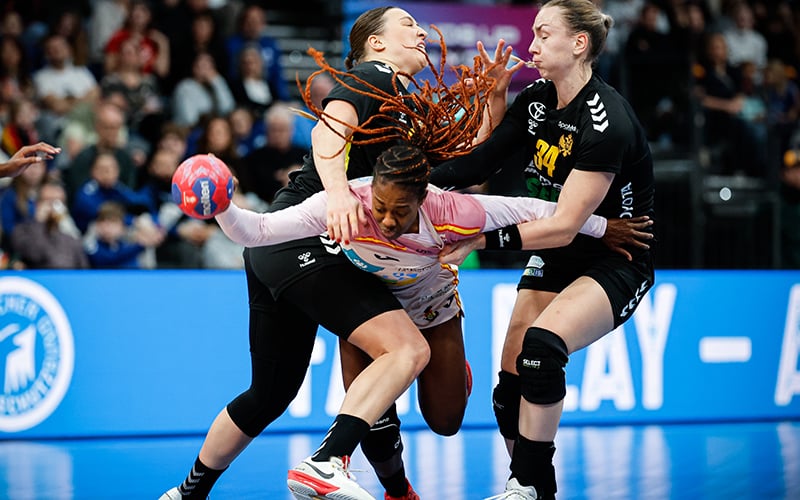
For Spain’s Danila So Delgado-Pinto, who entered the second week of the 2025 IHF Women’s World Championship as overall top-scorer (29 goals in four games), she can tell that story in multiple different languages: Spanish, Portuguese, Guinea-Bissau Creole, English, French and now, Romanian – just one of the abundant talents and skills outside of a handball court that she possesses.
A world of language
“It was the way I was raised,” says the engaging 24-year-old from the lobby of her hotel in Dortmund where her and her Spain team are based for the main round. “For immigrants, it is normal to grow up like this and there are many girls or boys and people in this same situation. I then had English at school in Spain where I have been living for my most of my life (she moved to Zaragoza at just one month old), so, by the age of the three, I was already hearing four languages.
“This world of communicating was always fascinating for me – being able to change between languages to speak with my cousins, my friends or even with my parents. My basic thoughts are in Spanish, because that's the language I use the most in my relationships, but I've dreamt before in English and I woke up and thought ‘that was weird’.
“I’m a really, really big fan of history of the world,” adds the player, who is rapidly approaching 50 national team appearances. “It really shows me how people managed through community, and how things change between. Language is a very good way to understand and learn about how the community spread and how it worked. It's a really big interest of mine to learn new languages wherever I go to because now, I'm playing in Romania, I'm trying my best with Romanian.”
Out of the comfort zone
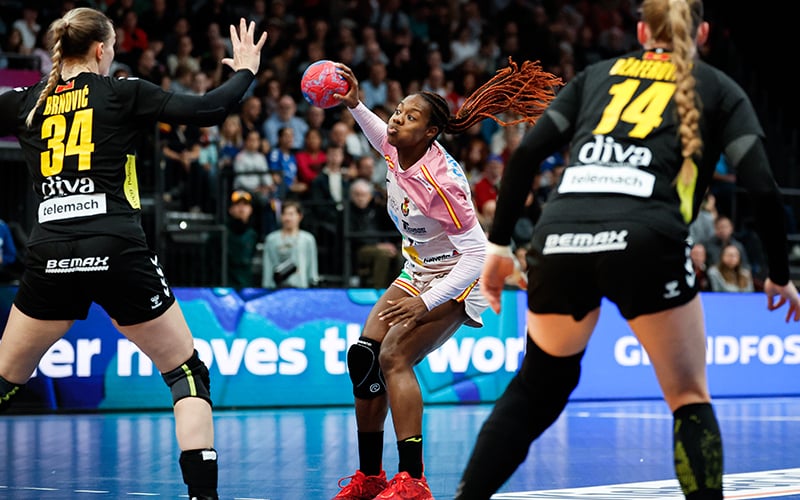
That move to Romania came back in June 2024, when So Delgado joined Gloria Bistrița from ATTICGO BM Elche, moving out of her comfort zone as a person and a player as she looked to step up her career in a league featuring some of the best players in the world.
“It has been very hard. I consider myself a mature person and I already knew it was going to be a big challenge, because it was a big change in every sense: I was living on my own, completely by myself and having to face a new team that I barely knew people in,” explains the player, who has scored 44 goals in the EHF Champions League this season.
“Feeling that loneliness for the first time was very overwhelming, and it was hard for me, but I had my parents, my boyfriend and my friends [to support me]. I had to learn a new language as maybe there were people that would not speak in English, so it was not a very big step to overcome, because I was very, very keen on learning Romanian.
“It is important for me because it makes a connection with the people you're living with. Being in their own country and them seeing that you're trying makes them more comfortable with someone that's foreign; they see that you're trying to appreciate their culture, the way they communicate, the way they manage themselves – that brings people together.”
And that experience in Romania, playing in a club alongside Spanish national teammates Paula Arcos and Kaba Gassama, amongst others, plus a variety of internationals, including Cristina Laslo, Larissa Nusser and Fujita Asuka, in a league packed full of global talent has helped as a player and individual.
“It gave me the confidence that maybe I was lacking,” says a thoughtful So Delgado. “The impact that the Romanian league has nowadays is very big. You're shown to a lot of teams and a lot of clubs and coaches. That made me feel better about my handball style, my own persona and the person I am as an athlete and that was the main reason. It also gave me matureness; everything I was lacking. It helped me to get to know what I'm capable of and what limits I can reach and overcome.”
So does she believe in limits? “No, I really don’t.”
Education key
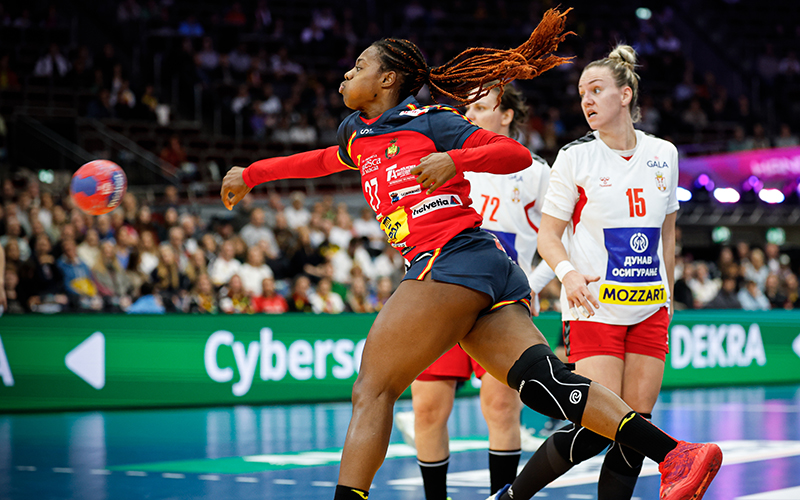
And that is abundantly clear as we move on to something completely different – her ongoing education. A source of immense pride for the Lisbon-born player, it is deep-rooted in her and her wider family history and something which is imperative to her well-being and future life.
“Firstly, I was raised in a home where I saw I had a lot of possibilities because of living in Spain. My parents came from Africa and it was not the same situation [as Spain],” she explained about the importance of continuing her education as an adult. “They always taught me that I needed to be an educated person, because the world needs educated people, so I was always passionate about learning stuff and being able to do stuff by myself.
“Secondly, I was really concerned about the fact that the sports career has an end, and I have to do something else. It helps me to be able to not only concentrate on this and cope with it, with my bad times, or my bad moments in handball, with something else.”
So Delgado is currently studying for her second Master’s degree, one which is on an educational pathway that has been adapted to suit her day job, that of a professional athlete – tough on its own, let alone with learning going alongside it.
“I started my first degree at the University of Barcelona when I was playing for Handbol Sant Quirz, then finished it at the Universidad Europea Miguel de Cervantes (Mi UEMC) in Valladolid when I moved to CD BM Aula. I then started my first Master’s, in Criminology, when I moved to Romania two years ago at an online university called Esneca,” she explains.
“The Universidad Europea Miguel de Cervantes were very, very, very helpful and very understanding. They actually have a programme to help athletes. They treated me very, very well and there were other students in the same situation as me, like my teammate here Elba Alvarez, who has finished her degree and is now doing a doctorate there.
“Now, I am studying for my second Master's degree – on Delinquency and Victimology – at the Valencian International University (VIU), online. Actually, here at the world championship, I am working on some little papers and work stuff for the university in my free time.”
Happiness and a healthy mind
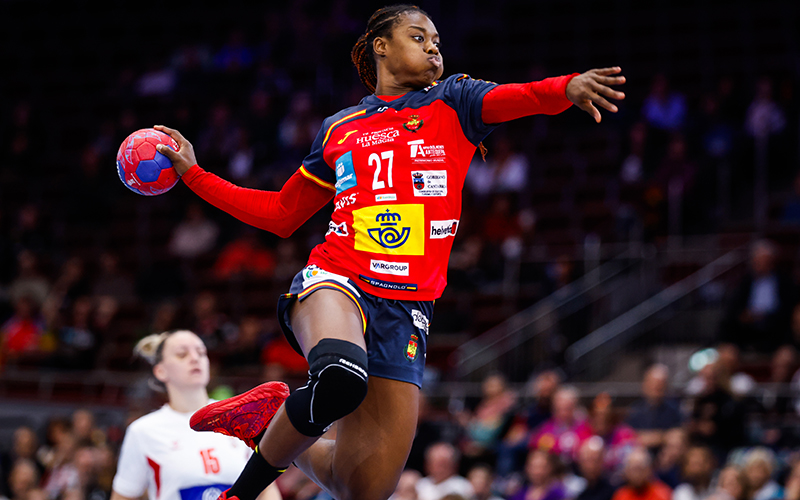
A lot of that free time is spent speaking to her parents, who have been with her through thick and thin and look out for the person first and player second.
“They are my main support, they always have been,” she says about her mother and father who live in Zaragoza, Spain, part of a family unit which also features two younger brothers.
“I know they would love to come and see me play and go with me wherever I go, but the possibilities are not like this, but they are always a phone call away. They are always super-worried about me and how I'm doing, not only handball but my studies, my mental state; they are my main support in my life.”
With mental health not a taboo in 2025, it is common now to see support for mental wellbeing amongst teams and individuals throughout the handball world, with the generation of So Delgado benefitting from the increased awareness and understanding of the issues surrounding the subject.
“It’s a fact that if you go with your mental health in a good way, the better you will perform and the better you will be able to maintain relationships – it's very, very important. To have your mind clear before games, before training, and to set up goals – what you need to move in your career,” explains the player.
“I have a personal mental coach, and I recommend this to every person, not only athletes, because it really helps you understand what point you are at and what are you trying to achieve.”
The inspirational Barbosa and Mangue
Delgado-Pinto dreams of qualifying for an Olympic Games with Spain and winning an IHF World Championship, as well as a Champions League at club level, with that handball journey starting at home.
One of the earliest handball memories for So Delgado was when she was a young child watching the legendary Alexandrina Cabral ‘Shandy’ Barbosa play for Spain on television.
And this image changed her life.
“As a nine-year-old watching handball for the first time on TV and seeing someone that looks identically like me; a black person playing handball, a woman, a leader, it was so representative for me. It showed me that there is a way to achieve something that I really, really wanted to have,” she said about Barbosa, who was also born in Portugal, and played for Gloria Bistrița.
“I really can remember that moment because I was watching the game with my father and we used to have conversations about Shandy or Marta Mangue because they were very big representative figures for us, not only for being black, but their presence as well. It's actually so, so, so important to keep shining the light on this subject: we should all try and not see the limits that maybe we encounter in other situations because of the lack of representation.”
Now, So Delgado is on the television – and phones and computers – herself, being watched by a generation of nine-year-old girls and boys all looking up to her. And this a responsibility she jumps at, grasping the opportunity with both hands.
“It’s so enjoyable as I really see myself in those kids, because I was those kids some time ago,” she says with her biggest smile of the interview so far.
“I really try my best to answer all the messages I get from the little girls or little boys that come from my city. They've been watching me play since I was a little kid; even the coaches and even my teammates. That's the part that I most enjoy about being on this level now, because I really want to send a message that’s not ‘if you can, you will’, because that's not realistic, but, ‘you have the possibilities to try’, because I tried and I got it.”
The here and now – regrouping and going again
So Delgado is speaking to ihf.info the day after losing to Serbia in an eight-goal turnaround defeat, which has dented – but not ended – their quarter-final hopes.
The young team, working in a new Olympic Games cycle and with one eye on their ‘Project 29’ initiative as they host the 2029 IHF Women’s World Championship in four years, are in danger of finishing outside the top eight for a second, successive event after leading by six as late as the 47th minute (26:20) before losing their crucial opening main round match, 31:29.
“We had it in our hands, and that's the most difficult part to accept, because that really makes us think what the problem can be, but we are also trying to keep the positive vibes going, because we have two matches left,” says the left back about the late loss.
“Even if we are able to qualify through or not, we really have to keep together for the group and for us to keep growing as a group, as a team, and that's the most important thing now, because we are a very young team. We've been playing together for two years now and I think that's too little to ask for results or achievements [yet].
“These kind of situations are bringing us more together, because they are forcing us to get to know each other faster than it may occur [naturally],” she answers in response to having a lead overturned in such a crucial game. “It's not necessary to have these moments to learn from them, but if we do, they are a really, really good lesson to really understand how we can manage ourselves in those moments.”
And So Delgado provided many of the positive moments for Spain in that loss, the Serbian media describing her play during the game – which featured 11 goals and two assists – as ‘unplayable’, ‘unstoppable’ and ‘impressive’.
“I had a very hard path to arrive here and feel the way I'm feeling nowadays here is confident,” she says in response to her feelings when hearing those words to describe her play.
“I am really feeling proud about myself. When things are clicking it's a relief, because I really worked hard to be able to perform like this.”