

How Spain mastered the art of winning at the IHF Women's Youth World Championship
10 Aug. 2026
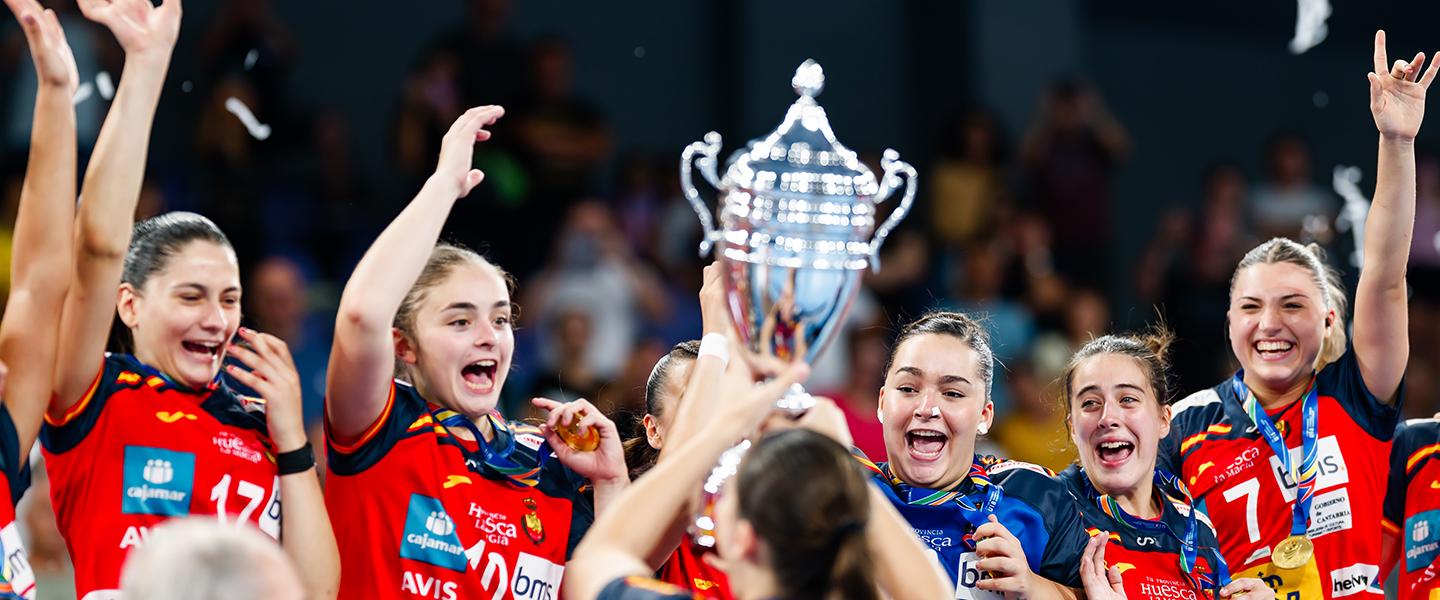
It was not easy, nor it was pretty, but few will remember the way Spain secured their second consecutive title at the IHF Women’s Youth World Championship.
Down three goals in the 45th minute of the final against Montenegro, 18;21, and two goals in the 49th minute, 20:22, “Las Guerreras” fought their way back into the final and conceded a single goal, scored by Montenegro with five seconds left on the clock, to clinch a 26:23 win.
By the time Montenegro scored their last goal of the final, Spain were on a 6:0 run, did not concede a goal for more than 10 minutes and were already celebrating the win, ecstatic about their hard-fought comeback.
“We knew Montenegro were going to play at this level. It was clear for us that they've been playing with practically the same seven or eight players throughout the entire championship and that, the moment we opened up their defense, we were going to have many opportunities,” said Spain’s coach, Cristina Cabeza, after the final, for the website of the Spanish Handball Federation.
Only two coaches had won two titles in the competition before Cabeza – Denmark’s Heine Eriksen in 2006 and 2012, and Russia’s Viacheslav Kirilenko in 2008 and 2016.
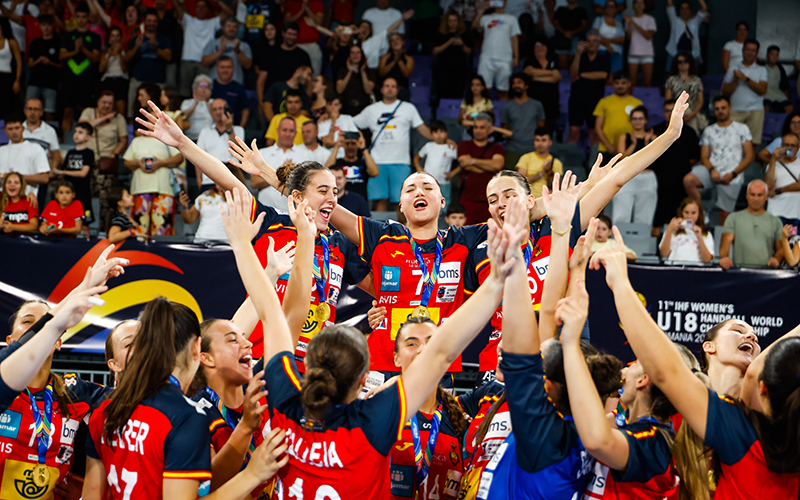
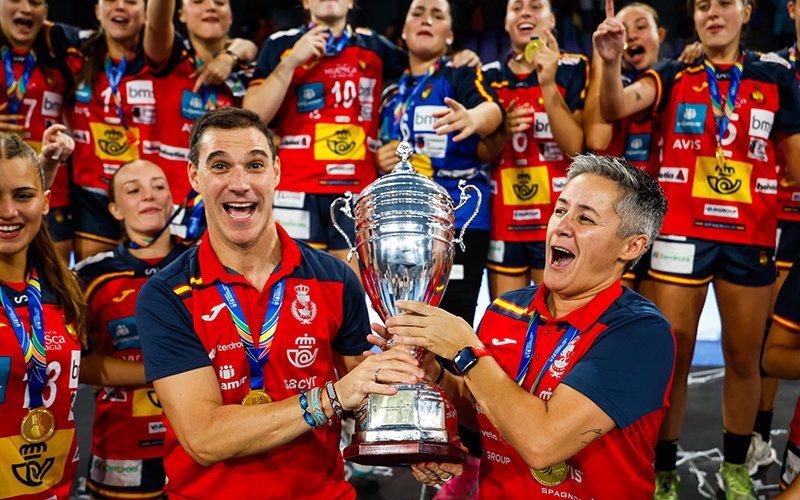
But now, the Spanish coach, alongside her assistant, Luis Miguel Ascorbe, will always be in the history of the competition.
Yet how did Spain turned something that looked like a lost match into their eighth win at Romania 2026 and, subsequently, the title?
Probably the best answer is the ability to adapt, plus a fantastic flexibility from the team and its coaches to pinpoint the problems and find sollutions in the heat of the moment to provide a platform for a comeback.
Throughout the competition, Cabeza rotated her outfield players, ensuring that only one of them played more than 300 minutes in the competition. Indeed, the players with the largest workload were the two wings – June Aguinagalde Viguria (324 minutes) and Erika Vladu (295 minutes).
By comparison, when the competition ended, Montenegro’s Andrea Dragnić spent 429 minutes on the court, Ivana Savić had 401 minutes on the court, Sofija Delević had 354 minutes played, and Jovana Tešović around 298 minutes.
That created a huge advantage, especially as Dragnić had 55 minutes and 35 seconds played in the final, Ivana Savić spent 54 minutes and 31 seconds on the court, while Andjelina Orbović featured for 52 minutes and 12 seconds.
The plan was simple: keep as close as possible and then hit in the dying minutes, when Montenegro’s energy reserves were down.
“I think the team believed in victory until the very end and matured a lot, especially in the second half of the matches,” said Cabeza.
The MVP of Romania 2026, Elene Fresco Bastarrika, spent 52 minutes, on the court, but Spain’s top scorer in the final, Lucia Calleja Velasco, had six goals in only 23 minutes and 39 seconds. Other players in the back line also featured for a little more than one half, setting up the tone for the final minutes.
And in those last 15 minutes, Spain did what they do best. Adapt, deploy a new tactic and force Montenegro to take risks. It worked and Spain are now world champions for the second time in a row, with only Russia, in 2016 and 2018, defending their title with a new generation.
“As it happened in the previous World Championship, we had a few tricks up our sleeve, like the 7 on 6 with only one pivot on the court, and it worked,” said Cabeza.
Indeed, Spain provided some excellent attacks by taking out their goalkeeper and Montenegro were left stunned. On the other side of the ball, Spain used their trademark aggressive defence, 3-3, or 3-2-1, and that also worked wonders, limiting Montenegro’s shots from the back line.
To sum up, Spain were the team with more depth – even after a devastating knee injury suffered in the final by Lucia Moreno Terrien – and the team which could adapt better in the final minutes of a long competition.
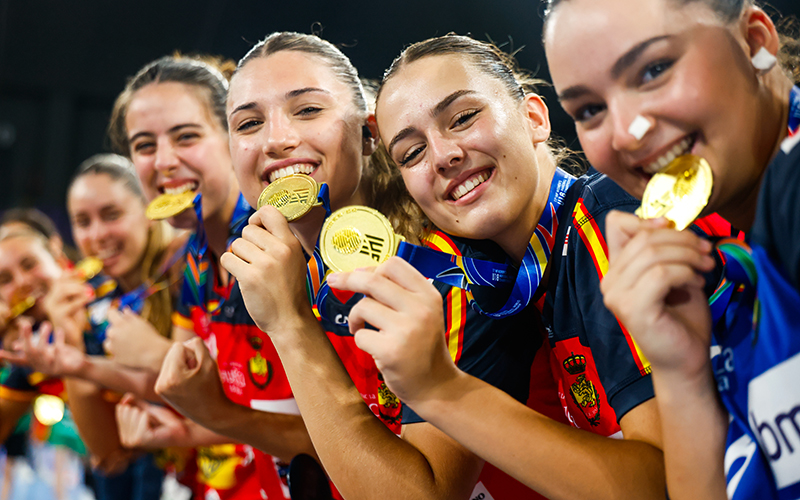
Just like in 2024, when Belen Rodriguez Lario, Marta Regordan or Goundo Gassama managed to keep Denmark at bay and secured a 23:22 win which helped them lift the title.
But even more so, with a coaching masterclass from Cristina Cabeza, and her assistant Luis Miguel Ascorbe.
“It is never easy to reach the final of a World Championship, especially with a different generation after winning the title two years ago. I'm also very happy to share this journey with my assistant coach, Luis Miguel Ascorbe. He is an incredibly hard worker, and it's a privilege to work alongside him every day,” said coach Cristina Cabeza for ihf.info, after the semi-final win against Egypt.
In total, Spain put together a series of 16 consecutive wins in the last two editions of the IHF Women’s Youth World Championship, which will surely be remembered as one of the vintage moments in the history of the competition.
In fact, the last time Spain lost a match at the IHF Women’s Youth World Championship was in 2022, when they dropped two matches in the preliminary round, against France and Hungary, and went on to win the President’s Cup.
“It seems easy, we're getting used to the good times, but we can assure you it's anything but easy. Making something complicated seem easy is a huge achievement for everyone here,” concluded Cabeza.