
Hosts Germany look for first medal in 20 years at the IHF Men's World Championship
17 Nov. 2026
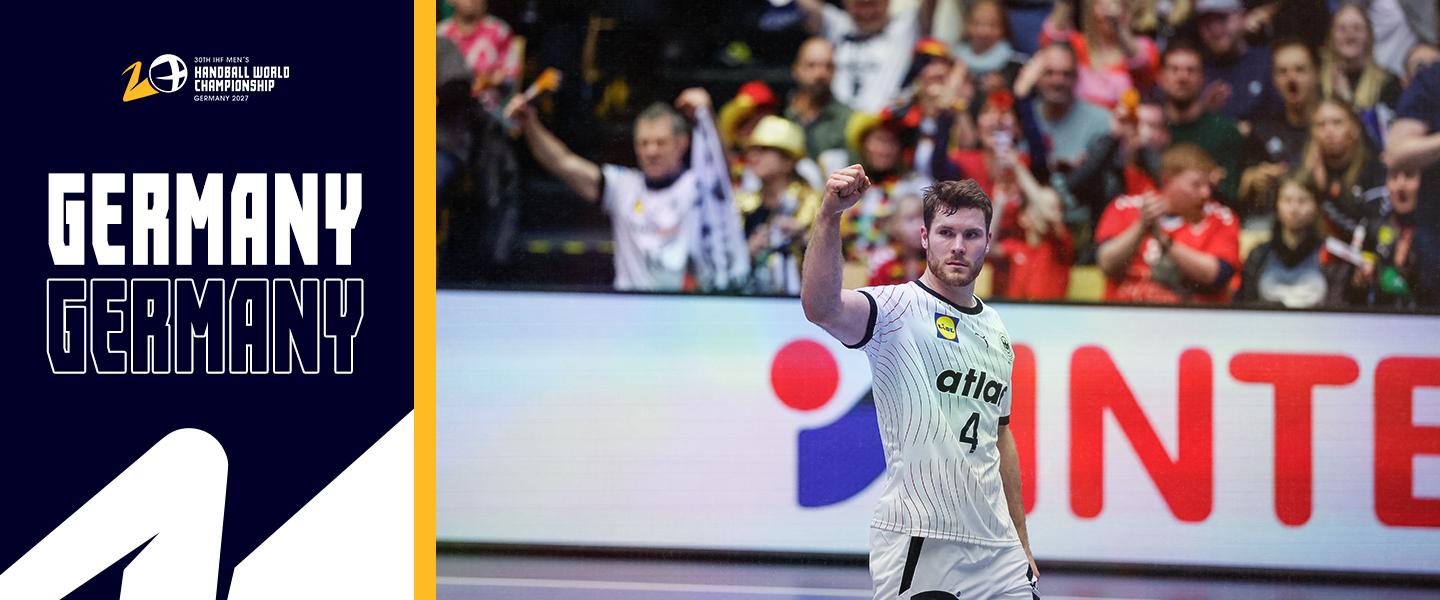
No team has played more matches at the IHF Men’s World Championship than Germany. No team has won more matches than Germany (131) and only one team – Spain – have scored more than Germany in the history of the competition.
However, Germany have been struggling to secure a medal in the world handball flagship completion since 2007, when they clinched their third world title. Coincidentally, that edition was hosted in Germany, just as this one, and the final was also played in the legendary LANXESS Arena in Cologne.
Since 2007, Germany made the quarter-finals six times, finishing fourth in 2019, when they also co-hosted with Denmark, and lost both times in this phase in 2023 and 2025, with the latter edition seeing Alfred Gislason’s side crashing out after a dramatic overtime loss against Portugal.
However, Germany have been back at their best over the last years, when a mix of experience infused with some fantastic youth talent – several world champions at the 2023 IHF Men’s Junior World Championship – brought Germany between the best teams in the world.
At the Paris 2024 Olympic Games, Germany reached the final, where they had little chance against Denmark, while at the EHF EURO 2026, the hosts of the 2027 IHF Men’s World Championship shrugged off a slow start to reach the final, where they pushed Denmark until the final moments, settling for the silver once again.
“Over the past few years, we have developed a clear structure within our team. We have grown – that is our strength,” said national coach Alfred Gislason, in a statement for the official website of the German Handball Federation (DHB).
With the 2027 IHF Men’s World Championship being a qualification event for the Los Angeles 2028 Olympic Games, Germany will have an eye of going as far as possible in the event, as the European side continues to benefit from having arguably the top league in the world, where Germany players are getting tested every week alongside the top stars in the world.
And Gislason’s extended 35-player roster, announced on 13 November, provides that type of cover on all positions, with experienced players all over the board, seconded by young guns, who have already proven their worth at the World Championship level in younger age categories.
Superstars like goalkeeper Andreas Wolff, backs Renars Uscins and Juri Knorr or line player Johannes Golla are complemented by Rasmus Ankermann, a 2025 IHF Men’s Youth World Championship winner, as well as M18 EHF EURO 2026 winner Toma Gadza. Nine players who won the 2023 IHF Men’s Junior World Championship, also co-hosted by Germany, are in the extended squad.
“Defining an expanded squad two months before a tournament, one that takes as many eventualities into account as possible, is a challenge. We have repeatedly experienced in recent years how quickly situations can change,” said Gislason.
Germany will have to navigate through several crucial tests on their way to the quarter-final of this edition of the World Championship. In Group A, they will be favoured against Serbia, Tunisia and Uruguay.
The most demanding test in the group is likely to come from Serbia, and the history between the two sides could hardly be more evenly poised. Including Serbia’s matches as Yugoslavia and as Serbia and Montenegro, the two nations have met 13 times across the World Championship, the EHF EURO and the Olympic Games. Each has won five times, and three encounters have ended level.
The Serbians, however, claimed the latest meeting of all, a 30:27 win in the preliminary round of the EHF EURO 2026 in Herning.
Against Tunisia, Germany won six of the seven meetings, while against Uruguay, Germany won 43:14 in the preliminary round at Egypt 2021.
However, if Germany progress to the main round, they will face three teams from Group B – with Egypt, Italy, Cape Verde and Saudi Arabia being possible opponents.
Key players: Juri Knorr (left back), Andreas Wolff (goalkeeper), Johannes Golla (line player), Renars Uscins (right back)
Coach: Alfred Gislason
Qualification: Hosts
History in the competition: 1938: Winners, 1954: Silver medal, 1958: Bronze medal, 1961: 4th, 1964: 4th, 1967: 6th, 1970: 5th, 1974: 9th, 1978: Winners, 1982: 7th, 1986: 7th, 1993: 6th, 1995: 4th, 1995: 5th, 1999: 5th, 2001: 8th, 2003: Silver medal, 2005: 9th, 2007: Winners, 2009: 5th, 2011: 11th, 2013: 5th, 2015: 7th, 2017: 9th, 2019: 4th, 2021: 12th, 2023: 5th, 2025: 6th
Group at Germany 2027: Group A (Germany, Serbia, Tunisia, Uruguay)