

Germany seal fourth title at the M18 EHF EURO, after big comeback
10 Aug. 2026
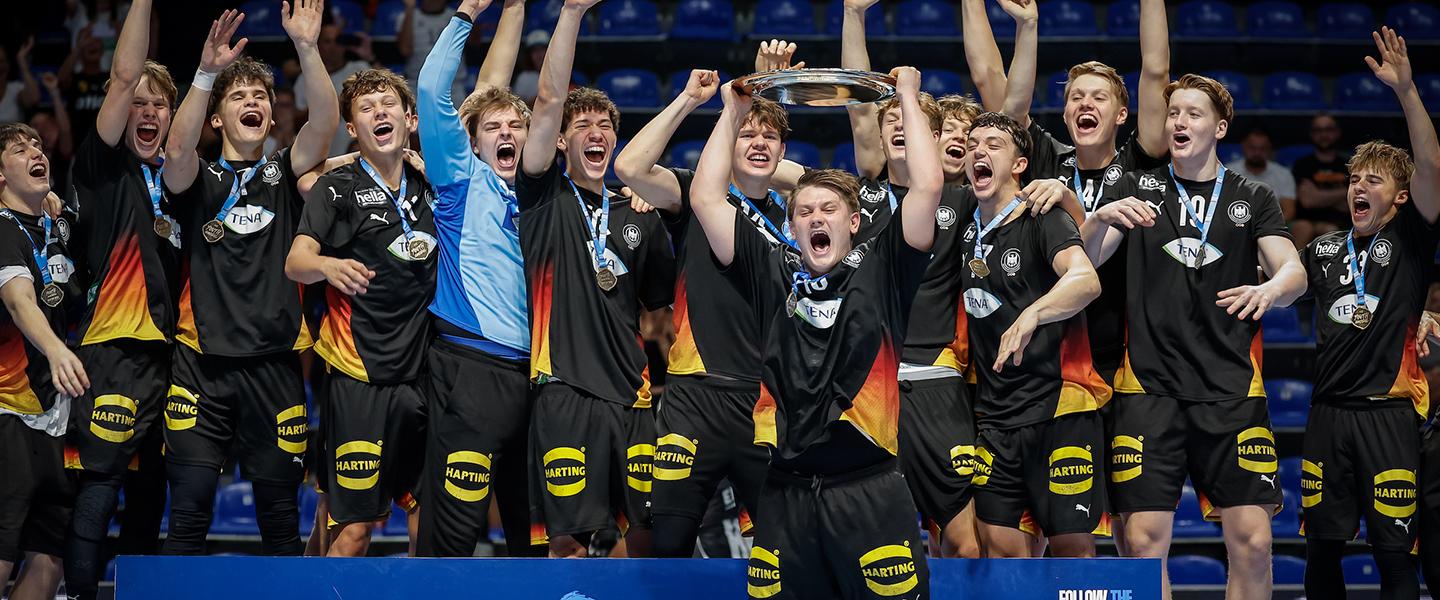
Germany moved to the top of the all-time standings in the history of the M18 EHF EURO, after securing the title in the 2026 edition, their fourth in history, with a dominating performance against Slovenia in the final, 36:27.
The M18 EHF EURO 2026 was a qualification event for the 2027 IHF Men’s Youth World Championship, and 14 teams plus Germany secured their places in the competition which will take place next summer.
24 teams lined up in the competition between 29 July and 9 August in Belgrade, Serbia, with the sides being divided into six groups of four teams each in the preliminary round, with the top two teams in each group advancing to the main round.
Germany’s start of the competition was not overwhelmingly strong, despite a 48:26 win against Italy and a 45:23 win against Türkiye, with the 27:27 draw against hosts Serbia providing some questions marks. Nevertheless, Germany and Serbia progressed to the main round from Group B, while in Group A, Slovenia shaped up to be a title contender, after wins against North Macedonia (33:30), Sweden (43:33) and France (34:30).
Croatia and Portugal progressed to the main round from Group C, in a battle for the ages, as Croatia won against Israel (33:29) and Portugal (26:24), but lost against Czechia (29:33). Portugal’s 27:25 win against Czechia also saw them through.
In Group D, Iceland, title favourites, swept their opponents, 39:25 against Montenegro, 41:28 against Hungary and 33:28 against Switzerland, with Hungary following them in the main round, while in Group E, Denmark and Poland powered through, with the Scandinavian side being unbeaten, including a 35:23 win against Poland. Norway were eliminated, after conceding a 26:32 loss against Poland.
In Group F, Spain beat the Faroe Islands, Finland and Austria, while Faroe made it to the main round, as their 38:31 win against Finland was crucial.
But in the main round, the tables turned for Germany, which conceded two losses against Slovenia (28:30) and France (28:29), finishing on the third place, behind Slovenia, which also beat Serbia and France.
However, with the system of the competition seeing the best two third-placed teams advancing to the quarter-finals, Germany were one of them, having a better goal difference (-3) than the Faroe Islands (-10), which also had one point.
In Group B, Iceland extended their winning streak to five matches, with big wins against Croatia (37:29) and Portugal (41:29), with Hungary and Croatia also qualifying for the quarter-finals.
Denmark also made it five out of five, after winning against Spain, 32:30, and the Faroe Islands, 32:27, with Spain being the other team from Group III of the main round to secure a place in the quarter-finals.
However, in the quarter-finals, Iceland did not have the strength to complete against Germany, and on the back of a nine-goal outing from Julius Eisend, Germany took a 33:31 win, eliminated Iceland and were in the hunt for the European title.
Denmark and Slovenia remained the only unbeaten teams, with wins over Croatia (38:30) and Hungary (32:27) respectively, while Spain also made the cut, with a 29:27 win against France.
Germany and Spain, two of the most talented teams at this age category over the last years, faced off in the semi-finals and Germany were the team to progress to the final, after a second half comeback, as Julius Pothke scored eight times on the way to a 32:27 win.
The second semi-final was dominated by Slovenia, who made it to the final with seven wins in a row, thanks to an excellent defensive performance, which enabled them to secure a 26:17 win against Denmark.
A rematch between Germany and Slovenia was on the cards for the title and this time around Germany started strong and never looked back, to add a record fourth title in this competition.
Vincent Faciejew scored eight times, while Eisend and Tim Bennet Thielicke scored five goals each, with Germany taking a 17:11 lead at the break, which proved to be decisive, as the final score was 36:27.
Denmark were the bronze medallists, after winning against Spain, 28:25, in the bronze-medal match.
Germany had already secured their place at the 2027 IHF Men’s Youth World Championship by clinching the title at the inaugural edition of the IHF Men’s Under-17 World Championship last year, therefore the next 14 teams in the final standings have secured their tickets for the event.
Slovenia, Denmark, Spain, Iceland, Hungary, France, Croatia, North Macedonia, Israel, Portugal, Austria, Sweden, Serbia and Poland are the teams which will take the court in the next event, scheduled between 29 July and 9 August.
M18 EHF EURO 2026 – All-Star team
Goalkeeper: Tjorven Knackstedt (GER)
Right wing: Maks Ilc (SLO)
Right back: Adrian Sola Basterra (ESP)
Centre back: Emil Kvistgaard Bak (DEN)
Left back: Julius Eisend (GER)
Left wing: Alex Unnar Hallgrímsson (ISL)
Line player: Malte Martin Elze (GER)
Defender: Tjas Erculj (SLO)
Top scorer: Yonathan Pelach (ISR) – 97 goals
MVP: Jaka Podvrsic (SLO)
Photo credit: Kolektiff