
Germany 2027: Saudi Arabia return to World Championship action with point to prove
27 Nov. 2026
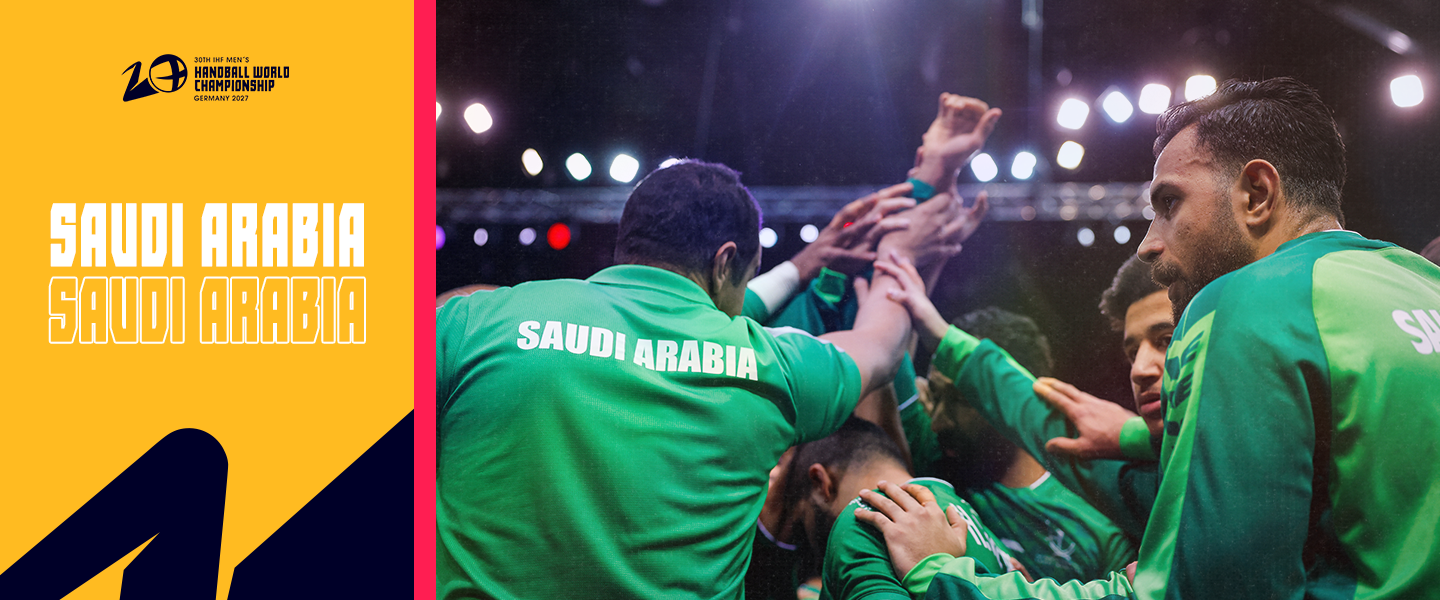
Saudi Arabia qualified for Germany 2027 after being awarded a wild card by the IHF Council in June in recognition as its positioning as ‘…one of the leading nations in the development of handball in Asia’…and for ‘…their sporting profile and continued progress of the game in the country’.
The Asian nation missed out on direct qualification at the 2026 AHF Men’s Asian Championship in Kuwait, missing out on one of the top four direct qualification positions, eventually finishing sixth after losing their 5/6 placement match against Korea Republic.
Germany 2027 represents the 30th anniversary of their world championship debut and the 11th time that the ‘Green Falcons’ have appeared at the global event. It comes four years after their last appearance (2023) when they finished in their lowest-ever ranking – 29th, with just a win against Uruguay in the President’s Cup and Morocco in the ranking game.
Overseeing that historic low was the legendary Danish coaching duo of Jan Pytlick and Morten Soubak who departed shortly after, succeeded by Icelander Erlingur Birgir Richardsson, who was then replaced by the short-lived spell of Isidoro Martinez who gave way to Greek coach Dimitris Dimitroulias.
This continued a long line of European coaching appointments stretching back to Spain 2013, with 1996 Olympic Champion Nenad Kljajic (Croatia), Goran Dzokic (Serbia), Fernando Barbeito and Luis Mariano Ortega Martínez (both Spain), Boris Denic (Slovenia) and Didier Dinart (France) all spending time in the hot seat, amongst others.
Now, the Saudis have turned to South America with Argentinean coach Guillermo Milano moving from the Chile women’s national team to take over the role.
And with 10 wins and 54 defeats in their 64 matches in the world championship history, Milano knows the task ahead for his side at Germany 2027 as they look to get closer to their best-ever ranking in the event – 19th in 2013.
His side have been drawn against Egypt, Cape Verde and Italy in their Germany 2027 preliminary group and will face a huge task to qualify through to the main round. Italy and Cape Verde have never been faced before in official competition, while Egypt and Saudi Arabia have met before with both ending in victories for the African side, both at the world championship preliminary group stage, in 1999 (19:16) and 2009 (26:18).
“It’s a demanding group, with three opponents that will present us with very different types of matches. Our goal is to be competitive in all three games and fight for a spot in the second round. To achieve this, we will need to tailor our game plan to each opponent while staying true to our own style of play,” says Milano to IHF.info.
“Egypt has experience in major competitions and, in my view, is a strong contender to finish among the top four in the world championship. Cape Verde possesses great physical power and features players who compete in top-tier leagues, such as those in Portugal, Spain, and Germany – that experience elevates their level of play.
“Italy continues to evolve. Over the last five years, they have shown that they belong in the second tier of European handball. They play at a high tempo, which will require us to stay focused throughout every phase of the match.”
Despite Milano overseeing the Saudi senior team for the first time at a senior world championship he is no stranger to the culture of handball in the country and its players.
“I have been living in Saudi Arabia since April 2026 after I arrived to coach the junior national team and then, a few months later, I also took charge of the senior national team,” explained the 53-year-old, who has also coached Macedonian club side RK Vardar as well as all ages of the Argentina men’s national team, leading the senior side at the Paris 2024 Olympic Games.
“Living and working in Saudi Arabia makes me very happy. It allows me to follow the players closely throughout the season, watch them compete for their clubs, and maintain regular contact with the coaching staff and the federation, which is involved in our process on a daily basis. Starting with the junior team also gave me the chance to get to know a generation of players whom we intend to gradually integrate into the senior national team.”
And his provisional squad for Germany 2027 features all 35 players based at home, including nine from Al Khaleej, a club which has appeared in the IHF Men's Club World Championship (formerly IHF Super Globe) a number of times under the guidance of Greek coach Dimitris Dimitroulias, who Milano replaced for the Saudi national team role.
“All of our players come from Saudi clubs. By monitoring the league and working with the youth and junior national teams, we are able to observe them in various settings and track their development,” explains Milano about identifying players for the national team.
“When we evaluate a player, we look at their performance, how they make decisions under pressure, how they adapt to different roles, and their potential for further growth. In my view, the transition to the senior national team should be gradual. Training camps allow us to bring in young players, see how they handle the intensity of the senior level, and provide them with specific goals to help them continue developing at their clubs.”
And that closeness and familiarity with each other, playing alongside or against each other week has ensured a team that has gelled together and has its own identity – ready to take on the challenge of Germany 2027.
“I see a committed group – players who are eager to learn and take on responsibility. I want that commitment to be reflected on the court, particularly in how we support one another defensively and maintain the composure needed to make good decisions under pressure,” said Milano.
“I want us to be an active, well-coordinated defensive unit—capable of winning the ball back and launching quick counterattacks. Offensively, I want us to have a variety of options to catch our opponents off guard. We also need to recognise when the match calls for a slower pace and when it’s better to pick up the speed.”
Captain Mahdi Al Salem is the most experienced world championship player with Saudi Arabia, having made his debut at the 2009 edition and appearing in every qualification since, while his brother Mojtaba Al Salem has appeared in five previous events.
And while coaches are loathe to single out players, Milano did take time out to praise a trio of key players, including both Al Salem’s.
“For me, key players—those who set the standard—are important because of what they do on the court and how they help younger players grow and take on responsibilities,” he said.
“I’d like to highlight Mojtaba Al Salem for his potential in one-on-one situations, and Ali Al Ibrahim for what he brings when playing between the lines. I would also point to our captain, Mahdi Al Salem, for his experience with the national team and his leadership on the defensive end but my priority as a coach is collective development.
“I want leadership to be shared, and for the team to maintain its level regardless of rotations, without relying on any single player,” he added. “Everyone must understand their role and feel prepared to step up, even in decisive moments.”
For their final preparations for Germany 2027, Saudi Arabia will commence a training camp in early December which will include a friendly against Qatar and two games against Tunisia.
The squad will then move to Europe and continue their camp in North Macedonia, with two friendly games against their hosts and one against Kosovo. In early January they move to Luxembourg for games against their hosts as well as Belgium before travelling on to Stuttgart for their preliminary group.
“These matches will allow us to test different rotations, fine-tune the transition from defence to counter attack and solidify each player’s role ahead of the world championship,” concludes Milano.
Coach: Guillermo Milano
Key players: Mojtaba Al Salem (centre back), Ali Al Ibrahim (pivot), Mahdi Al Salem (pivot)
Qualification for Germany 2027: Wild Card
History in the competition: 1997: 21st, 1999: 22nd, 2001: 21st, 2003: 19th, 2009: 23rd, 2013: 19th, 2015: 22nd, 2017: 20th, 2019: 19th, 2023: 29th
Group at Germany 2027: Group B (Italy, Cape Verde, Egypt, Saudi Arabia)