

"Genius is in simplicity": Lithuania, the team that came from nowhere, gets ready for the IHF Wheelchair Handball World Championship
25 Aug. 2026
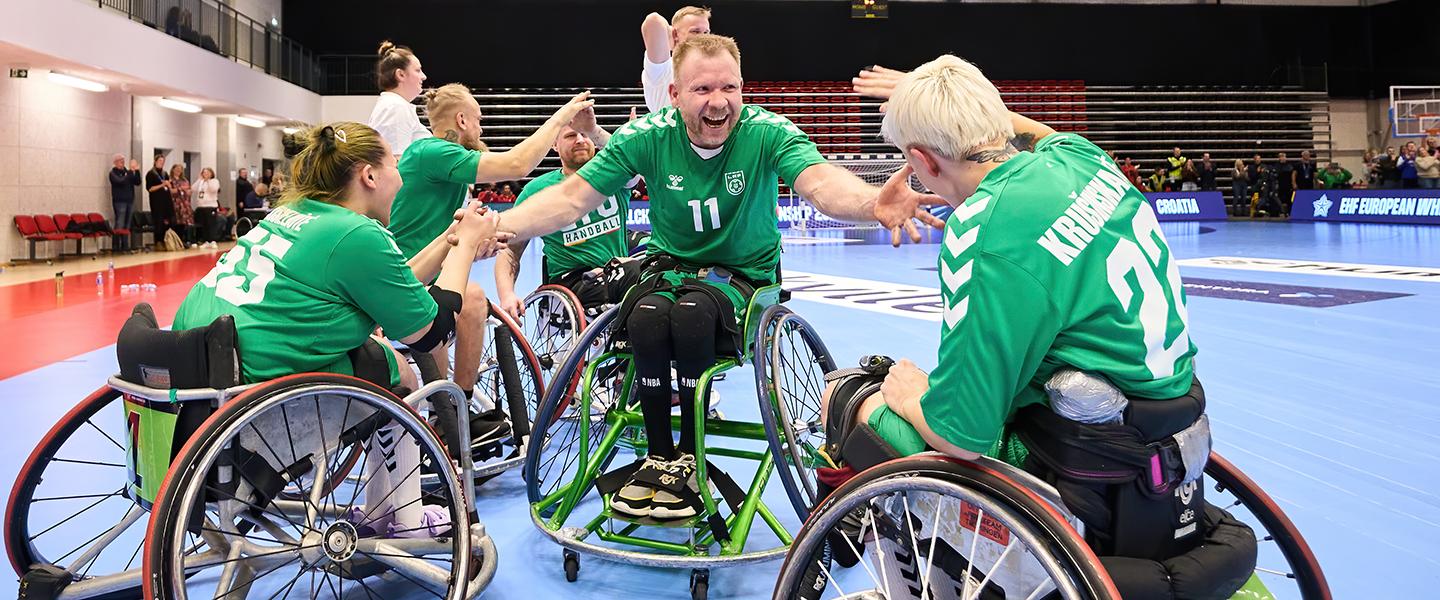
It all started with a phone call. Paulius Glaska had been churning the idea over for a long time before he finally picked up the phone and asked a friend, the coach he trusted most, a simple question: did he want to try something that didn't exist in Lithuania yet?
"I called my friend, our head coach, Karolis Kaladinskas, and asked him: do you want to try and see what happens?" Glaska, the Chairman of the Lithuanian Association of Physical Activity for People with Disabilities, recalls.
"He agreed, and we started a little project that became a big thing."
That was the beginning of wheelchair handball in Lithuania, in November 2024. A handful of athletes turned up to the first session. Within a couple of months, there was a full team, staff included. Merely one year later, that same team stood on a podium at the EHF European Wheelchair Handball Championship in Vilnius, wearing bronze medals and holding a ticket to the 2026 IHF Wheelchair Handball World Championship in Granollers, Spain, which will take place between 16 and 20 September 2026.
"When we thought 'let's try', and we finally had a European Championship where we won bronze, that was something unbelievable," Glaska says. He is careful, though, not to let the speed of it all disguise how unusual that timeline really was. "Realistically, it's not that easy to do everything in one year, especially when the conditions for training aren't what you need. Everything was being built from zero. Finances, courts, adapted goals that we didn't have in Lithuania at all until a few months before the European Championship, staff. I would say that realistically it would take two to three years."
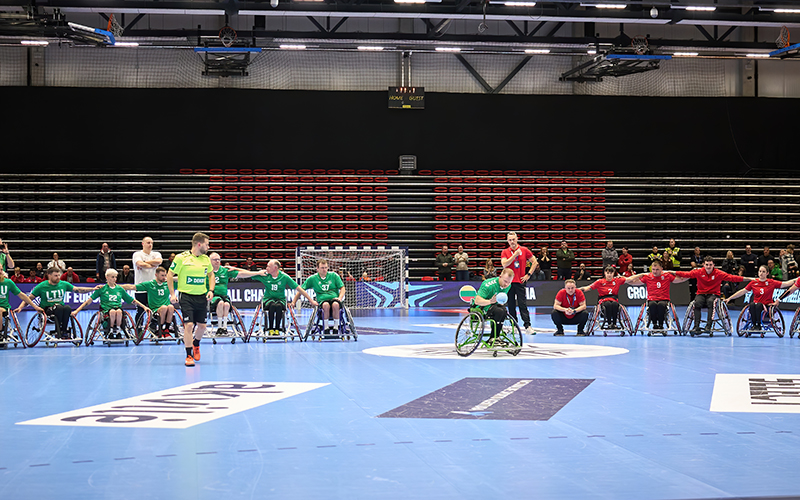
Lithuania credit their exceptional rise to the top, getting there faster partly because it played its first major competition on home ground.
There was no travel, and a familiar arena there to comfort the players. None of the disruption that usually accompanies a debut played a part.
But Glaska is equally clear that speed alone doesn't explain it. What he circles around is the group itself, which made huge sacrificies to get here.
The athletes drove in from different cities across the country, arriving every second weekend for training camps, building something out in a short amount of time.
"Everything that we have is because of them. Team spirit, big effort and strong will," Glaska says.
And on the top of all, Lithuania had a coach who knew handball. Karolis Kaladinskas built his reputation over two decades in indoor and beach handball, most notably leading Lithuania's senior women's national team. Wheelchair handball wasn't part of that plan.
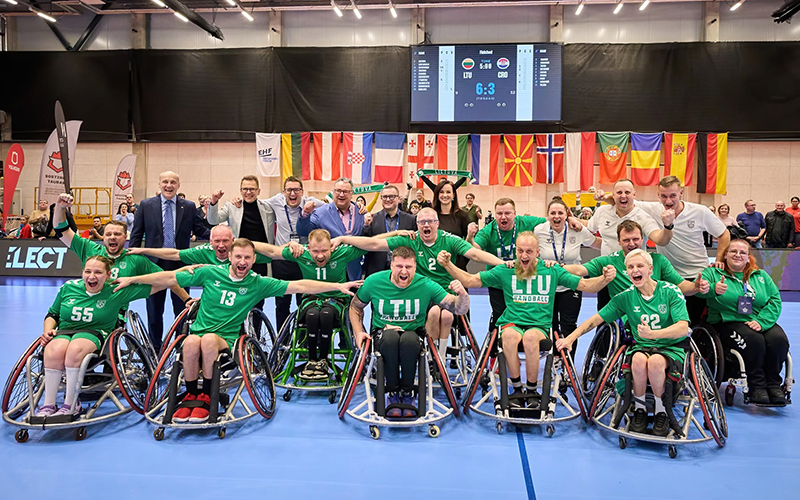
"I've been working in handball for 20 years, and I ended up in wheelchair handball completely by accident," he says.
Glaska adds some sugar on the top, underlining the unexpected rise: a coach who had never seen wheelchair sport before last year has, in his view, become one of the best in the discipline.
Kaladinskas brings something specific with him from his experience in indoor handball and beach handball.
The scoring system in beach handball shares its core with the four-a-side wheelchair game, and he has leaned on that experience while building his team's identity.
"Genius is in simplicity," Kaladinskas says.
“I have been working with beach handball for many years. It's a similar point-scoring system, and some tactical elements will be borrowed from there."
But his approach is really a coaching one and is a defence-first mindset which kickstarted everything: "The tactic starts with defense. Our team members help me a lot."
That defence provided some good moments at the Wheelchair EHF EURO 2025, when Lithuania topped their group, a fantastic affair between five teams which all ended on four points, winning two matches and conceding other two. But Lithuania had the best set difference, +2, and went on to the semi-finals where they lost in straight sets against France, 0:2.
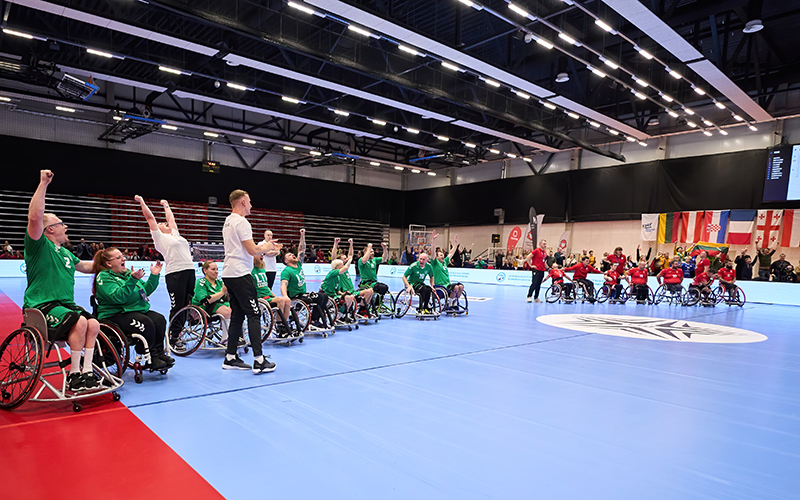
They bounced back admirably and took a 2:1 win against Croatia in the bronze-medal match, ending up on the podium.
Facing already established European sides in Vilnius could easily have tipped into intimidation. Kaladinskas didn't let it.
"If you want to be among the best, you have to beat the best, but we will go into every game like it's a new battle. Our young team won't pay attention to rivals and we will try to beat everybody," says Kaladinskas.
Building a squad from scratch meant starting almost everywhere at once. Some of Lithuania's players arrived from other wheelchair sports, basketball, athletics, swimming among them.
Increasingly, though, the programme is drawing in people with no competitive sporting background at all.
"Now we have much more players that aren't from other sports, and we're trying to include as many people with disabilities as we can. We have a really good programme where we're learning from each other,” adds Glaska.
That same instinct will be tested again in Granollers, where Lithuania has been drawn in a group alongside reigning champions Egypt, as well as Chile, a team which took part in the previous two editions of the IHF Wheelchair World Championship.
But how did the recruitment programme start?
One priority came before any other. Wheelchair handball requires a female player on court at all times, which meant Glaska's search for talent had to start there.
"Without them, we can't play at all," he says. Three women were part of the squad in Vilnius and more have joined since. Glaska speaks about them with particular pride, aware that their role on court differs from their male teammates', and that the rule itself changes how the whole team has to be built.
"It makes playing more interesting, with some challenges in how to merge them with the men."
But for Lithuania, this edition of the IHF Wheelchair Handball World Championship is a milestone.
The Baltic country has two appearances in a World Championship – the women’s last appeared in 1993 and the men’s in 1997 – and now they will be represented once again, with great ambitions.
"Wheelchair handball came almost from nowhere, and now we are at this big event. We are all waiting for the World Championship to see what we are worth," adds Glaska.
Ask Glaska who carries that weight inside the squad, and he resists picking out one player over another, insisting every one of them has a story worth telling. He makes one exception. Team captain Edgaras Ciaplinskas holds the group together off the court as much as on it, keeping communication flowing between athletes, staff, the coach, the team manager and the federation.
"The discipline he has developed, and his experience in other sports, mean a great deal to our entire team," Glaska says.
For Kaladinskas, what happens on the scoreboard in Granollers is almost beside the point. Asked what success would actually look like, his answer has nothing to do with results. "The measure of success in the championship is just one thing: staying a team in every sense, and enjoying the game."
Photo credit: Lithuania Handball Federation