

Coaching courses in People's Republic of China and Japan mark new milestones for handball's growth in Asia
05 Aug. 2026
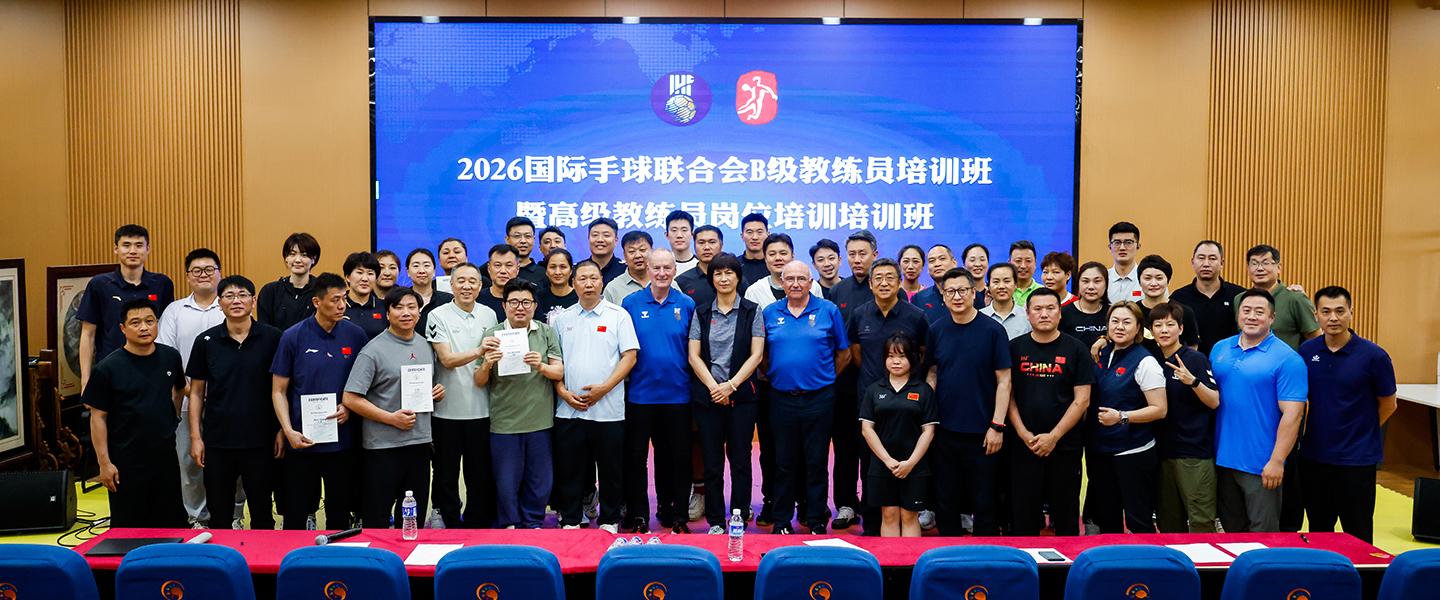
The International Handball Federation's push to build coaching infrastructure across new and developing markets reached two significant milestones this summer, with landmark courses held in China and Japan within weeks of each other - each representing a new tier of qualification for the region.
In China, an IHF B-Licence Course ran from 19 to 26 June 2026 in collaboration with the Chinese Handball Association, part of the IHF New Markets Programme established with the country, and took place on the outskirts of the 2026 IHF Women's Junior World Championship. The course built on several years of groundwork: an online coaching course reached 180 participants in 2023, followed by a series of C-Licence courses, before this B-Licence edition marked a new milestone for Chinese coaching education.
Thirty-nine Chinese coaches took part, drawn from head coaching roles with various national squads as well as leading positions across the country's provincial programmes. Among them, 13 of the 39 participants were women - all of them now coaching after their own playing careers with the Chinese women's national team, a detail that points to a broader pipeline of former internationals moving into coaching roles as the sport professionalises further in the country.
The course was led by Dietrich Späte, Chairman of the IHF Coaches Commission (CCM), alongside Paul Landuré of the CCM and CCM expert Jorge Dueñas. Yerime Sylla, head coach of the Chinese women's national team, joined as a guest lecturer. For many of the Chinese coaches, the format itself was as new as the content: the course's heavy reliance on interactive small-group work marked a departure from more traditional instruction, though it was received constructively and positively by participants throughout the week.
On content, the course placed particular emphasis on individual and group-tactical defensive training, an area organisers identified as often overlooked in Chinese youth development, alongside broader work on adapting to how quickly the sport itself has evolved in recent years. Organisation was handled in close cooperation with Kechang Zhang of the Chinese Handball Association, with state-of-the-art teaching media, interpreters with strong handball-specific expertise, and high-level demonstration teams supporting the practical sessions.
The coaches in the room were consistently younger than in comparable programmes elsewhere, with strong long-term potential to shape the sport's development in China going forward. A first IHF A-Licence course for the country is already scheduled for 2027.
Three weeks later, attention shifted to Tokyo, where the first-ever IHF A-Licence Course for Asia was held from 12 to 20 July 2026 at the Ajinomoto National Training Center, organised with the Asian Handball Federation (AHF) as part of the two-year transition period for implementing the IHF's licensing structure across the continent. It followed on from B-Licence courses held in Kuwait and Tokyo in 2025, representing the next step up in the region's coaching pathway.
Twenty-two coaches from eight Asian countries took part, including five women's coaches from the Philippines, Korea, Japan and Iran. The course was again led by Dietrich Späte and Paul Landuré, joined this time by CCM expert Nabeel Taha, with Denmark's Morten Soubak, head coach of the Japanese women's national team, serving as guest lecturer - at one point leading a live training session with the Japanese women's national team as part of the course itself.
A central theme throughout was how the tactical playing philosophy in Asian handball, particularly in Japan and the Republic of Korea, might be developed further to close the gap with European teams over the medium term. That included a tactical breakdown of the Asian Men's Handball Championship held in Kuwait in January 2026, alongside sessions on the third wave in fast-break play, modern approaches to positional attack, and building more flexible, active defensive systems.
Sports psychology also featured prominently, led by Nabeel Taha of Bahrain, one of the more prominent international voices in the field. His sessions covered the modern elite coach mindset, coaching under pressure, mental skills for elite players, and how to integrate mental performance work into daily training. Participants worked in small groups throughout, with seven groups ultimately presenting their own vision for a modern, evolved tactical concept, using professional-standard presentations that included animated video and tactical graphics.
The course was organised by Eiko Yamada, High Performance Sport Director at the Japan Handball Association, supported by her staff team, with simultaneous translation systems covering multiple languages and strong demonstration squads drawn from Japan's top university teams supporting the practical work. It is expected to be the first of several targeted initiatives for Asian handball development in the coming years.