

‘I feel like I’m alive’ – life after playing suiting legendary Lekic
30 Jan. 2026

“I need to call the Secretary General”, says former Serbia captain Andrea Lekic, standing in the Serbian team hotel the morning after their come-from-behind victory against Spain in the main round of the 2025 IHF Women’s World Championship in Dortmund, Germany.
The former IHF World Player of the Year is at her first IHF Women's World Championship edition in her new role at the Handball Federation of Serbia (RSS) as General Manager of Serbia's women's national handball teams.
A quick chat with the Secretary General on the phone follows and then she is ready – her energy, positiveness and focus quickly apparent as she switches to the interview.
The purpose
After retiring at the end of last season it did not take long for Lekic to return to the sport, taking over her new role in September.
I finished my career at the beginning of June and as an athlete you want to take a rest, but my head doesn't function properly if I take a long rest. We (Lekic and the RSS) had quite long talks, it took two months, but I really do love this sport more than anything in this world and when you have a chance to do this – and you know that many kids are looking up to you in your own country – it feels like a responsibility and I enjoy that. It's a privilege.
We are trying to put in place a system from youth to senior categories to function together, something I think we have never had before. That means establishing communication and coordination between the coaches, physical coaches, psychologists, and all other things. We are talented nation, but we didn’t have proper physical care; we always lose in this physical part – we're playing well in the first round, but it’s a really long and physical tournament and, as we can see, the Scandinavians and the countries who are dominating, what is that system? The big difference is physical power.
We are putting the responsibility of physical performance on the girls as number one. We're talking about the basics. We want to educate the younger generation that nothing comes without the work, not only on the court, but physical and mental performance, additional food habits, healthy habits – education about healthy habits is one of the priorities.

And that was my first task; to bring in the physical coach and she’s doing such great stuff. Hopefully, in March, we are having a mental coach with us in all categories, not just the senior level. In 2013, we had a psychologist, mental support and he did great. They help you to go through the struggle, but the way how they help communicating and connecting you with the team is great.
Sometimes we are playing with people for 10 years, five, two or even one year together, and you still don't know if they have siblings, how they feel, if they have family, if they have friends. So I decided to – I don't want to say help – but influence the building of this system.
I really hope that it’s going to last as we want to make handball massive and that means getting girls into handball. The national team is a big way to bring the kids onto the court because it has the biggest number of people watching.

The rest day role
Lekic certainly brings her own physical power to her new role, with constant phone calls, greetings and questions during the interview not only from the Serbian delegation but others in the handball family who know her from her more than quarter-century of service to the community.
And that role at a World Championship is split clearly between matchday and non-match day, or rest day, activities.
For a typical rest day after a match, I wake up, check my phone and there is usually like 30 requests already, that's completely different than what I had when I was a player.
That is a lot of requests, but it’s because I'm also in communication here with the management, the media team, the General Secretary and President of the RSS, sponsors, PR, the embassy, many people who are coming to meet the team.
We are gathering information and impressions after the matches. What could be better? What we should change? What and where should we improve? I go through the squad with the physical coach, see how it looks and what their plans are. We are thinking about all the aspects of the game, having talks with coaches, how they feel, what they want, how they see the match, what their approach is.
We try to make the players happy on their rest days with the schedule, but it is always flexible because it's a very tough tournament where we are together for almost three weeks.

I'm involved in every decision which is made on a daily basis. We have our communication group where everyone is giving ideas and having daily meetings after dinner every time to hear everything. I want to hear everyone from the coaching staff to the staff who are working in the organisation.
I try to talk with the girls a lot. These talks can be formal (in analysis) or informal, but they are friendly. I want to hear them. I want to have an individual approach to each and every player. I want to know their background. I want to know how they function. I want to know how they feel. It’s different being a player. You don't have many possibilities to have extremely open talks so I'm trying to gain their trust. I want to know what their struggles are.
I have to give them all the credit. We really try to make them feel good with small things, details and these kinds of things. We are really obsessed in a beautiful way about how they feel and that's very important. There is always a group of older players who are really mature and have been through everything so they also have some things to do, because they should and, together, we are managing the load quite great.
Today was the first day that I finally went training at the gym, because when they train, usually I am busy.

The matchday role
From the relative calm of a rest day, Lekic and the Serbia team then have a more, fixed routine for their matchdays. With a game every two days, this cycle continues throughout the lifetime of a championship, with matchdays having little flexibility.
It’s a whole intense day. I usually walk up before the team. I like to have breakfast a bit before everyone, before the rush starts.
Then we go through the training, which is usually some kind of activation. I try to stick with the players for the whole day. That's very important. We have already talked about the match, about the technical and tactical details. I have played with them (Jovana Risovic, Katarina Krpez Slezak, Dragana Cvijic) and know a lot of them, so we can talk and I'm super happy it’s like that. We are exchanging thoughts about the matches and I like it, and I feel I'm alive. They also feel confidence in that they can talk about that.
There is usually lunch followed by a small rest. In this moment, if the game is 6pm or later, I try to have 1.5 hours for myself, even doing visualisation, still being in that player mode, because I still feel pretty alive next to the court.

The legend role
With those Champions League and World Championship medals, plus the IHF World Player of the Year Award and one of just four players for pass scoring 1,000 goals in Europe’s top club event, Lekic has rightly earned legendary status in Serbian, European and World handball.
And it is no surprise that the former centre back is now regularly called a legend by the media, fellow players and coaches. But with that status and her new role, could new, younger players to the squad be slightly nervous in her company?
It’s true, but I try to be very relaxed. I am a very open person and I really don't behave as a ‘legend’ or a player who won things – I don't think that this brings any quality to the talk.
I feel it and I leave it. I don't influence it. I'm just taking a step back, taking my time, having small talks, until it comes to a big talk. I put myself in their own position, their own shoes. I always say I have been there, done that, so you can surprise me with your background, family and friends but you cannot surprise me with the feelings on court. This is what I lived. I have been up and down many times and that's my advantage; I can understand them. I didn't forget how it feels. That's the most important point.
The moment I came here I had one very open talk with them all and I said I'm here for everything. Everything means everything means everything.
I am learning what it means be ‘Andrea’ now, who is ‘Andrea’ after the handball court? I'm processing, it's ‘loading’ as they say (referencing the ‘loading’ gif seen on social media). It's loading in a good way. I'm getting better. The players make my percent better. They make my life easier. When you are feeling good in your skin, and the girls are too, seeing them happy makes me happy. That's the loading thing. My heart is beating for this one. This is not even a question mark.

But since I'm outside of the court now, I have much more time to have insights into things happening. When I was a player, you don't think about that. You’re in a complete bubble. You have your schedule, and you know all the times. I try to transmit that on them. I don't hide it.
It's important for them to understand that we have been ‘in the dark’ for many, many years. We still don't have any crucial results, so I cannot say, ‘wow, we are doing well’, but we have been really good in this world championship, and that means the world to us. Finally, after 2013 we had a handball euphoria in Belgrade which is beautiful and I'm truly happy because that's one of the goals.
It's important for them to know there is a euphoria there, because it's important to feel a beautiful responsibility on their shoulders and that's something really unbelievable now.
When you are doing something what you love the most, and you feel loved and appreciated you have to be grateful for that and you have to also be aware of responsibility and of your public image.

Switching off
With so many responsibilities to consider, plans to make and a championship to consider, Lekic has found the new role exhausting a times but as the tournament continued, like she did on court, she adapted and found a way.
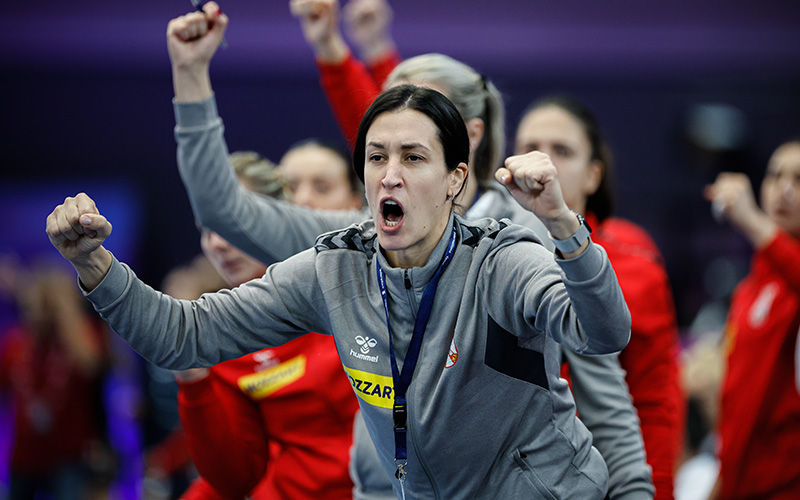
It's a different load of a stress, much higher than when you're a player and I think no one can expect that. Honestly, you don't know that until you sitting at the match. I'm learning how to cope with the stress throughout the match. I learned that I have to control my emotions. I lost my voice for three days from screaming at game but I think showing emotions, clapping people on the shoulder, giving them a high-five it means you're loaded with support.
I have to tell you that I had an issue with switching off, I mean a true issue. I had a real lack of sleep in Stuttgart for the preliminary round. It was my first championship doing this so it was really hard for me to shut down the head. I basically slept every night for four hours and I was exhausted. The biggest issue for me was the level of adrenaline I had, one that I never experienced before at matches. It hit me on the rest days and I was physically really struggling, but moving to Dortmund for the main round I feel much more calm, it's much better as I’m getting used to it.

I am coping with it by creating awareness of it. During your professional career as a player, you know what is important for you and what is not. So, I started making a small balance, taking walks after dinner, turning the phone off and listening to music for 30-45 minutes. That helps a lot.
As a player you're taking care of yourself mostly, but in this role, it has been very challenging. I'm much more on the phone than I used to be. I have joked that when the world championship finishes, I will collapse, but I'm still riding on the wave. I love it truly, and I really want to see us winning. I want to see us be happy. That's my motto.
Thanks to the players as a group feeling me as a part of them and giving me the trust for everything, I'm really feeling happy in this role. I'm really grateful. It's important that we don't feel these three weeks as a struggle. We should feel these three weeks as having a good time, a privilege.

Handball family
IHF.info also followed Andrea on her morning session in a local gym with the team on a rest day, which was captured by IHF photographer Jure Erzen.
During this visit the Norwegian team were also using the facility, with Andrea meeting up with legendary players and former club teammates Katrine Lunde (Gyor 2011-2013) and Nora Mork (CSM București 2019-2020), plus Norway goalkeeping coach Mats Olsson.
You win many medals, trophies and things throughout your career, but what really counts are the people that you meet along the way. That is my own biggest blessing. In handball, the journey is the point. It's not the destination. I really, truly mean it, because I went through ups and downs like hell, and I had these people standing next by my side. I had the privilege to play with them.
It's a pleasure and a fortune meeting these kinds of legends and still calling them friends, but it’s a mutual thing. You need to give from yourself to deserve it. It doesn't come for granted. You need to invest yourself in relations.
When I'm talking about investing yourself, I mean in every relation on a daily basis. And it comes back, it pays back, just being honest and really staying true to yourself, it's not a simple sentence, it's hard and not easy to do it.