

What to know about the inaugural IHF Women’s Under-16 World Championship
09 Oct. 2026
On 16 October 2026, a new milestone in women’s handball will be reached as the inaugural IHF Women’s Under-16 World Championship gets underway in Agadir, Morocco. The first edition will bring together 16 national teams from five continents, offering some of the sport’s youngest talents their first opportunity to compete for a world title at IHF level.
Following the introduction of the IHF Men’s Under-17 World Championship in 2025, the new women’s competition extends the international pathway for young players, adding another stage between grassroots handball and the established youth and junior World Championships.
What is the purpose of the new competition? The IHF Women’s Under-16 World Championship is designed to give promising young players international experience at an earlier stage of their development. It complements the existing IHF Women’s Youth World Championship at the Under-18 level and the IHF Women’s Junior World Championship at Under-20 level, creating a complete pyramid and an improved pathway for the next generation of female players.
The tournament also provides an opportunity for teams from different handball traditions to meet on the world stage. With 16 participating nations representing Africa, Asia, Europe, North America and the Caribbean, and South and Central America, the competition reflects the global reach of the sport.
The decision of the IHF Council to expand the Women’s U16 and Men’s U17 World Championships from 12 to 16 teams further strengthens this pathway, giving more young players the chance to experience international competition.
What is the format of the 1st IHF Women’s U16 World Championship? The 16 participating teams have been divided into four preliminary-round groups of four teams each. The group winners will advance to the semi-finals, while the remaining teams will compete in classification matches to determine their final positions.
The draw, held in Cairo, Egypt, on 24 September 2026, produced the following groups:
Group A: People’s Republic of China, Morocco, United States of America, Kazakhstan
Group B: Hungary, Paraguay, Guinea, Belarus
Group C: Germany, Uzbekistan, Mexico, Tunisia
Group D: Argentina, Egypt, Switzerland, Russia
The preliminary round will take place on 16, 18 and 20 October. The semi-finals will follow on 22 October, before the competition concludes on 24 October, when the inaugural world champions will be crowned. That means that every matchday is followed by a rest day, taking the players' welfare into account.
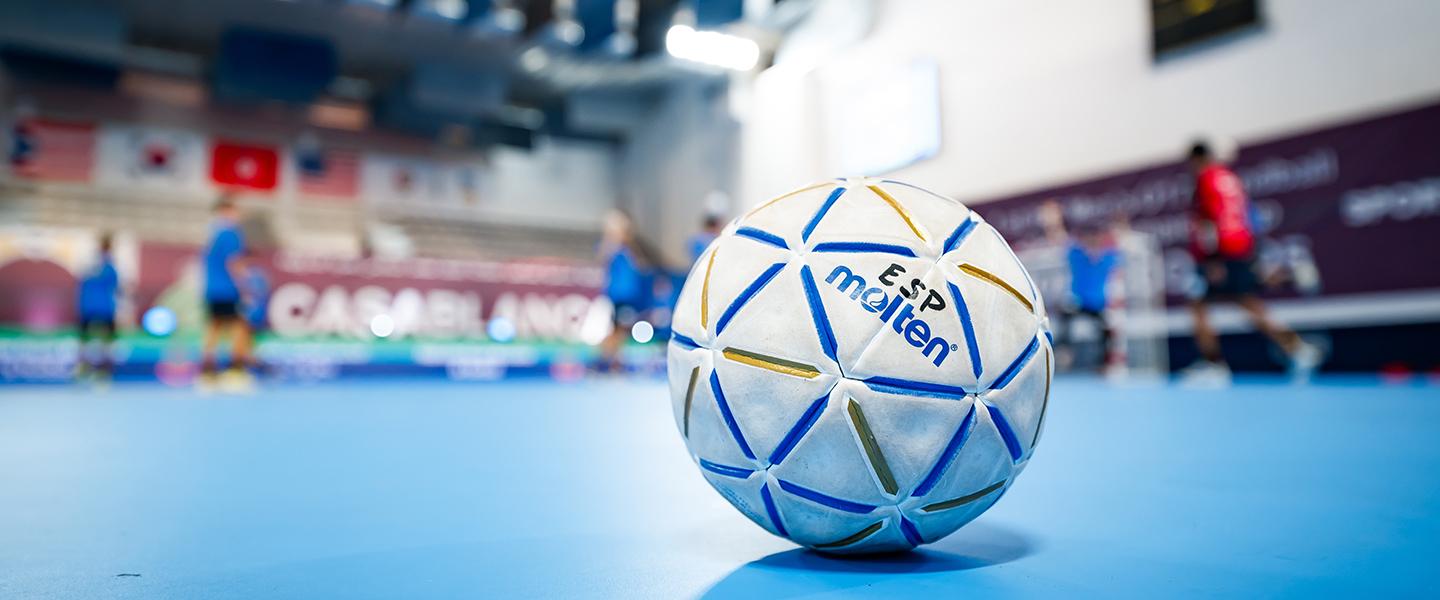
How are the matches being played? Matches will consist of two 30-minute halves, with a 10-minute half-time break. The teams will use a size 2 resin-free ball, and the use of resin, glue or any other adhesive agent is not permitted.
Each side will play five matches during the championship, ensuring that every participant gains further experience on the international stage, regardless of its results in the opening phase. Up to 16 players may be included on the match roster, with a maximum of five team officials permitted to participate in the match.
Are there any special rules? Yes. As introduced at the inaugural IHF Men’s Under-17 World Championship in 2025, the Women’s Under-16 competition will operate under an adapted set of rules designed to support player development and encourage open, attacking handball.
One of the main provisions concerns substitutions. Court players may be replaced only when their team is in possession of the ball, meaning that regular substitutions between attack and defence are not permitted. The exception concerns injured players, for whom the relevant provisions of the IHF Rules of the Game apply. A substitution made while the team is not in possession of the ball is considered faulty and results in a two-minute suspension for the incoming player. Substitutions are also permitted during a team time-out.
The rules also restrict the use of the goalkeeper in attack. Teams must have a goalkeeper on the court at all times and may not replace the goalkeeper with an additional court player to create a seven-on-six attacking situation. A court player may take on the goalkeeper’s role in accordance with the standard rules, but the goalkeeper is not allowed to cross the centre line and enter the opponents’ half. A violation results in a two-minute suspension, or a red card if the goalkeeper causes a frontal collision in accordance with the relevant rule.
These adaptations are intended to keep the focus on the development of players in both attack and defence, while creating a framework that rewards handball played with greater freedom and initiative.
Why is a resin-free ball being used? The use of a resin-free size 2 ball is another feature carried over from the inaugural Men’s Under-17 World Championship and the youth and junior IHF Trophy events. The approach supports the broader objectives of player welfare and more sustainable playing environments, while allowing young athletes to develop their technique without relying on adhesive agents.
The ball was also used at previous IHF youth events and has featured throughout the IHF Trophy programme across the continents, giving players and coaches experience of the equipment before arriving at the world championship.
Three referees on the court: With the new rules implemented over the last decade, handball has definitely grown, but so has the challenge for these rules to be correctly overseen by the referees. A referee’s job is to apply the rules fairly and create a fair-play environment on the court while taking over hundreds of decisions in a single match. Therefore, the IHF has resorted to using three referees on the court, with the 2022 IHF Men’s Club World Championship being the first competition where the system was introduced. In 2025, the three-referee project has also been used for the entire 2025 IHF Men’s Emerging Nations Championship and in the President’s Cup at the 2025 IHF Men’s Youth World Championship. The system was also used for the entirety of the 2025 IHF Men’s Under-17 World Championship.