

IHF Forum 2026 brings handball community together to shape the future of the game
02 Oct. 2026

The future of handball was placed firmly at the centre of the conversation in Cairo on Friday, as coaches, players, referees, delegates, continental representatives, commercial experts and leading figures from across the handball world came together for the 2026 IHF Forum - The Further Development of Handball.
Held at the St. Regis New Capital Hotel in the New Administrative Capital, the Forum brought together voices with very different perspectives on the sport, but a shared interest in how handball can continue to evolve.
Rather than being a conference built around a series of presentations, the Forum was designed as an open exchange. After opening sessions featuring IOC Associate Director for Summer Sports and IF Relations David Luckes and Sportfive Chief Growth Officer Robert Müller von Vultejus, participants divided into three working groups, each approaching the future of handball from a different angle.
The composition of the groups reflected that ambition. Among those taking part were Spain men's senior team head coach Jordi Ribera, France men's senior team head coach Talant Dujshebaev, Germany women’s head coach Markus Gaugisch and former Norway women’s head coach Thorir Hergeirsson. Athletes and former players were represented by Gonzalo Pérez de Vargas, chairman of the IHF Athletes’ Commission, and Katrine Lunde, chairwoman of the IHF Women’s Handball Working Group. Referees, technical experts, continental leaders and commercial partners were also part of the discussions.
The Handball Brand
The first working group, The Handball Brand, examined perhaps one of the most fundamental questions facing the sport: how handball presents itself to the world, and how it can become more relevant to audiences who have not yet made the sport part of their sporting lives.
The group looked at the current handball landscape and the changing expectations of fans, with particular attention paid to Gen Z and Gen Alpha. The conversation then moved towards the IHF brand itself: its presence at competitions and on screen, its perception within the handball community and the importance of consistency and recognition.

The discussion around social media formed an important part of this work. The current state of IHF social media, areas for future development and the road towards the Los Angeles 2028 Olympic Games were among the subjects on the table, alongside the wider challenge of reaching new audiences and creating stronger, lasting relationships with existing fans.
The group also considered what happens beyond the match itself. Live coverage, highlights and news remain central, but the conversation explored the potential of documentaries, stories and additional content around matches. Competition structures, formats and the in-venue experience were also examined, with the participants considering how IHF events can become more engaging experiences for spectators.
With representatives of Sportfive - the IHF exclusive global media and marketing partner - IHF experts and figures from partners including Gerflor and Molten contributing to the discussion, the group brought together perspectives from sport, media, commercial development and technology.
Game and Rule Development
In the second group, the discussion turned directly to the game itself.
The Game and Rule Development group, moderated by Per Morten Sødal, Chairman of the IHF Playing Rules and Referees Commission (PRC), and Dietrich Späte, Chairman of the IHF Commission of Coaching and Methods (CCM), looked at how the rules can continue to serve the development of handball while making the sport easier to understand and follow.

One of the central themes was the complexity of the rules for new spectators. The Rules of the Game were placed at the top of the agenda, with the wider objective of making handball more accessible to people who are encountering it for the first time.
The discussion around attacks without a goalkeeper returned to the increasingly important seven-on-six situation. Participants considered its development, the impact and value of suspensions and what role this tactical option should have in the future of the sport.
Video replay was another major point of discussion. Its purpose and role in handball were examined alongside developments in other sports and possible future applications, including the potential role of a Coach’s Challenge. Rule interpretation was also scrutinised, with blocks, punishment criteria and competing for space among the situations considered by the group. Passive play and the repeated foul and free-throw situations that can follow the forewarning signal were also addressed.
That perspective was strengthened by the presence of people who experience the rules from completely different positions on the court. Pérez de Vargas brought the athletes’ perspective, while Ribera, Dujshebaev, Gaugisch and Hergeirsson represented coaching experience at the highest level. Former and active referees and technical experts were also directly involved in the discussion.
Continental Development
The third group, Continental Development, widened the focus from the game itself to the global development of handball.
Moderated by IHF First Vice-President Philippe Bana and co-moderated by CCM member Paul Landuré, the group brought together the presidents of the continental confederations, IHF experts and representatives responsible for development, education and competitions.
The starting point was deliberately global: what does handball development look like across the different continents today, and where are the greatest opportunities?
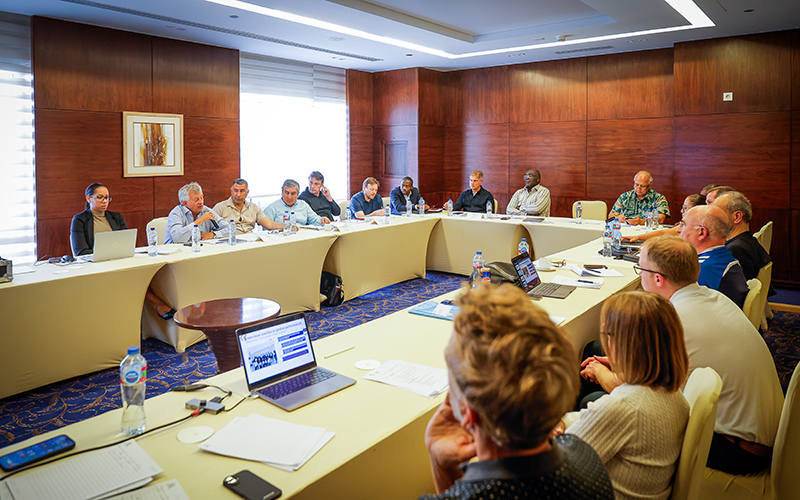
The participants examined findings from questionnaires submitted by the Continental Confederations and discussed differences in performance levels. From there, the conversation moved towards region-specific strategies, recognising that a development model that works in one part of the world cannot simply be transferred unchanged to another.
Youth and talent development programmes were part of the discussion. Marketing, promotion and social media development for Continental Confederations also featured prominently, as did the possibility of staging more IHF events outside Europe in order to strengthen handball's global identity.
The IHF Four-Year Plan was also placed within this wider framework, with participants discussing the foundations of a development programme for selected Member Federations, including selection criteria, priorities, targets, implementation and monitoring.
The presence of continental leaders from Asia, Africa, Europe, North America and the Caribbean, South and Central America and Oceania gave the conversation a genuinely worldwide dimension.

From discussion to action
After the first working sessions, the participants reconvened for a further two-hour round of discussions before returning to the plenary room for presentations, questions and debate. The day concluded with a final summary and discussion.
The ideas generated in Cairo will now be examined by the IHF with a view to identifying those that can be developed and implemented in the future.