

‘Handball is becoming a core part of Oceania’s sporting identity’ – Collins and Kiribati excited about future
10 Sep. 2026
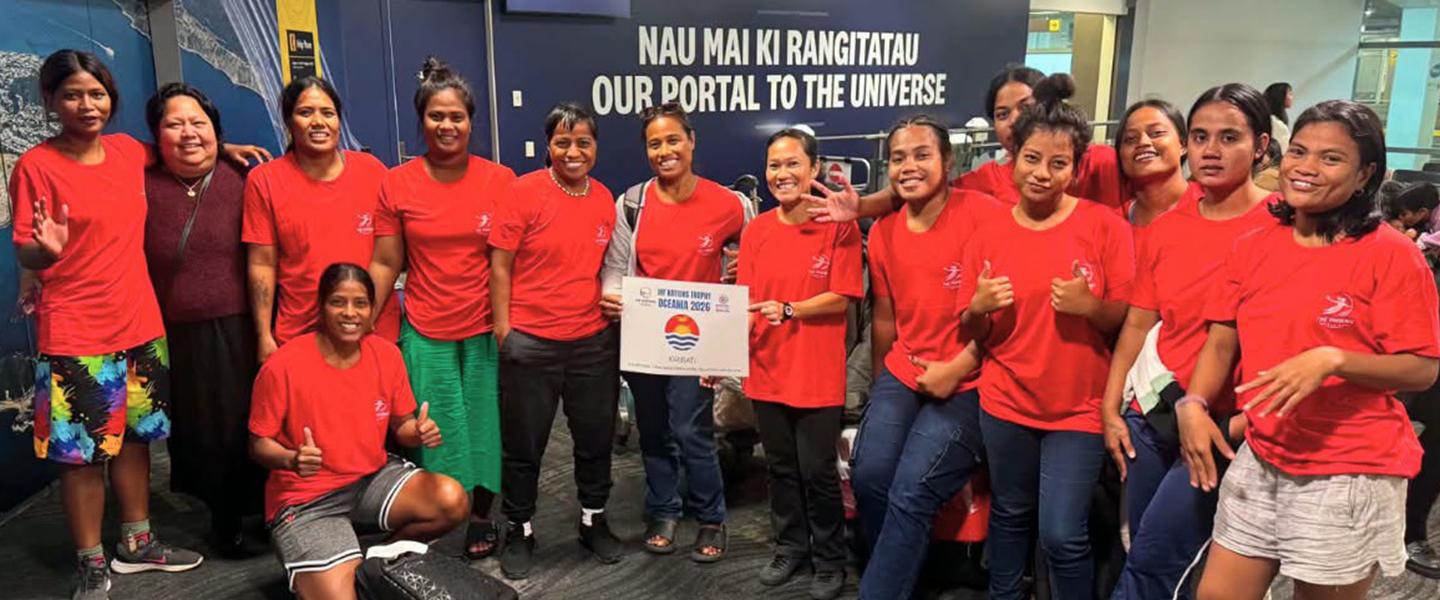
‘Kiribati is a nation of extremes – a vast, blue territory with a tiny landmass, uniquely positioned to be the first country to greet the dawn,’ says the Government tourist agency for Kiribati at kiribatitourism.gov.ki – and extreme it is.
The ‘Exclusive Economic Zone (EEZ)’ of Kiribati covers over three million square kilometres of ocean, making it one of the largest maritime nations, despite a land area of only 811 square kilometres spread over the three main island groups of the Gilbert Islands, home to the capital and over half of the population of 130,000 (on the Tarawa Atoll), along with the Phoenix Islands and the Line Islands. The nation's main administration is located in South Tarawa (Gilbert Group).
A small chunk of that 130,000 will be missing this week as Kiribati’s national women’s handball team are competing at the Oceania Continent Handball Federation (OCHF) IHF Nations Trophy which throws off on Thursday (10 September) before finishing on Monday (14 September).
“We are extremely excited to be part of the inaugural Oceania IHF Nations Trophy Championship as, for Kiribati, this marks a historic moment and a proud achievement for our athletes, coaches, and community,” says Kiribati Handball Federation President David Collins, to ihf.info.
“Our hope is to perform with pride, discipline, and unity. We aim to compete strongly in every match, earn respect through our effort and inspire young athletes back home.”
Kiribati find themselves in a group alongside the host nation New Zealand, as well as New Caledonia, and the Cook Islands. Their campaign throws-off on Thursday against New Caledonia, with New Zealand on Friday then the Cook Islands on Saturday, with their chances of progression through to the knockout stages and possible Asian Championship qualification clear once the preliminary stage concludes.
“Our group is a challenging but exciting one,” says Collins. “Each opponent brings a unique style and strong handball tradition. We respect all teams, but we also believe in our preparation and determination.
“We are looking forward to the professional environment, high-quality facilities, and strong handball culture in New Zealand. It’s a valuable opportunity for our players to gain international exposure and experience a well-organised tournament. This tournament is a major milestone for the Kiribati Handball Federation and it validates the hard work invested in developing the sport and gives us a platform to grow even further.”
Collins and his team are one of seven teams competing in Wellington, the four from their group joined by Australia, Fiji and Tahiti in group B.
And that number of nations competing in one venue in the vastness of the Oceania region shows what can happen and what can be possible when everyone works together for a common goal, according to Collins.
“The participation of seven nations shows that handball in Oceania is growing stronger, more organised and increasingly competitive. It reflects the collective effort across the region to elevate the sport and also highlights the momentum behind women’s handball,” he explains.
“More nations are investing in women’s programmes and the depth of participation shows that women’s handball is becoming a core part of Oceania’s sporting identity.”