

‘A great honour’ – Australia’s pathway for success starts in New Zealand
10 Sep. 2026
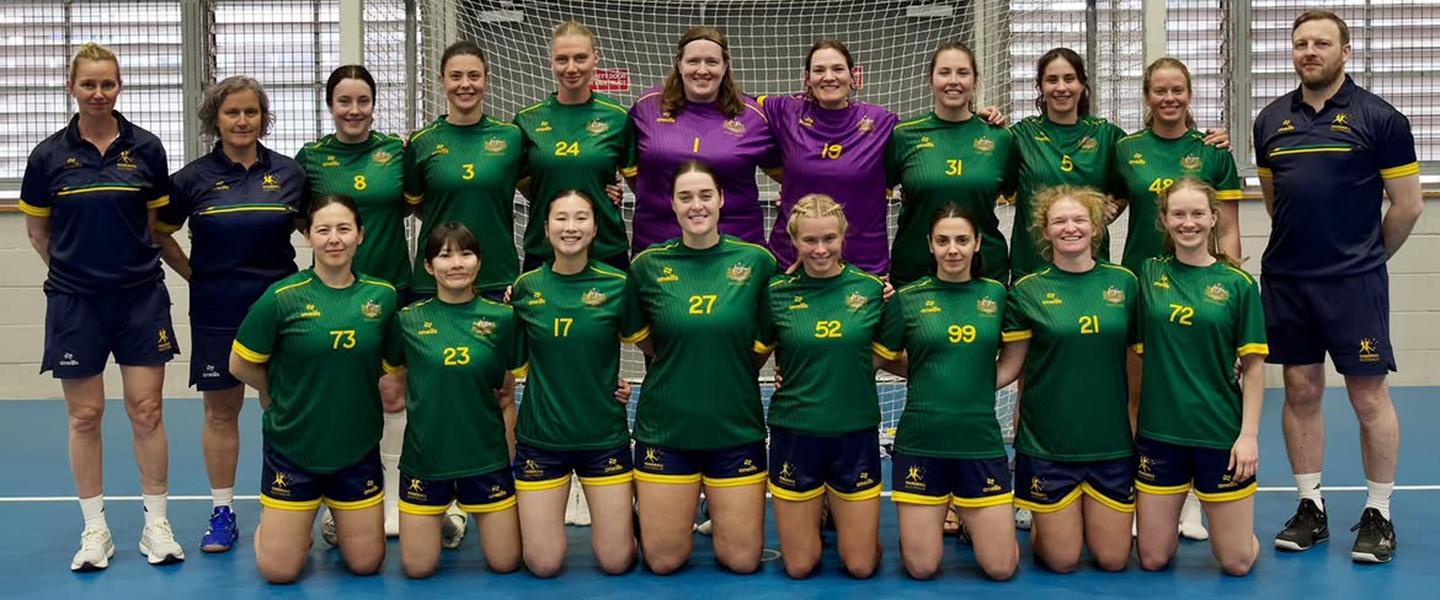
As winners of all seven women’s Oceania Handball Nations Cup events which took place from the 1990s through to the mid-2010s, Australia know all about taking continental honours.
Five of those golds were won at home and two in Wellington, New Zealand – the same city which will host the inaugural Oceania Continent Handball Federation (OCHF) IHF Nations Trophy this week (10 to 14 September).
The new competition continues the legacy of the Nations Cup and provides a pathway through to possible IHF Women’s World Championship qualification with the winners in Wellington moving into the AHF Women’s Asian Championship later this year.
Taking to the court at the Ākau Tangi Sports Centre alongside Australia will be Fiji, Cook Islands, New Caledonia, Kiribati, Tahiti and host nation New Zealand in the seven-nation competition.
“It was a surprise but a welcome one,” says the Women’s Programme Head Coach, Eoin Murray, to ihf.info about the seven Oceania teams coming together for what is one of the biggest-ever indoor women’s events held in the continent.
“One of our major barriers to development is the lack of competitive matches so this competition allows us to give some international experience to a lot of young new players with over half the squad making their senior debuts and only three or four who've played more than a handful of games.”
With teams from Australia and New Zealand the only representatives in the previous women’s editions of the Oceania Handball Nations Cup, the addition of five more nations makes the IHF Nations Trophy this week not only an exciting prospect, but a chance to celebrate the breadth of handball in the Oceania region.
“Having seven teams participating is a great indicator that the youth and junior Oceania event initiatives have been successful in boosting regional expansion of indoor handball and also at a senior level too,” says Australia’s Ane Olsson Skjaeret.
“It also showcases the efforts the nations of Oceania have put in to grow the sport in a sustainable manner and that we are closing the gender representation gap. It proves we have taken a major leap forward in athletic funding, infrastructure and player retention for women and those who want to compete at an international level across the Pacific, and that makes us all incredibly proud.
“It is not an easy feat considering there are very limited resources and few opportunities to play competitive games in the region,” she added. “We obviously want to come out of this tournament with a trophy, but being a part of this project is amazing in its own right. We hope it can show how much fun there is to be had for future generations of handballers in Oceania.”
An education and a handball career on the other side of the world
Skjaeret’s story is a good example of the diversity of backgrounds which make up the Australian playing squad.
Born and raised in Norway, she started playing handball when she was around five or six years old at her local club Klæbu, in Trondheim, later transferring to Byåsen when she was older. After completing a degree in psychology in Trondheim she moved to Australia to graduate from the Graduate Diploma and Masters of Chiropractic programme at Macquarie University in Sydney.
Now ‘Dr Skjaeret’, she had already immersed herself in the Australian handball culture, playing for UTS (University of Technology Sydney) Handball Club as well as the University of Queensland, including appearing at the inaugural IHF Women’s Super Globe in China back in 2019.
And Skjaeret will make her Australia debut this week in New Zealand after being granted her Australian citizenship last year.
“Better late than never as they say,” she says with a smile. “Even though I just recently became eligible I have been training and playing with these girls for a long time, so I am really looking forward to finally being able to share the court with them at an international tournament.
“I’m very excited to be part of the first edition of this tournament. It is a great opportunity for us to gain some valuable game experience before, hopefully, taking the step up to the Asian Championship later this year.”
And Skjaeret is a result of just how much work and effort Handball Australia put into casting their net to search for, and identify, talent.
“We are talent ID-ing through our junior and schools competitions and finally have a consistent pathway structure for them to come into. We also look at talent transferring very talented athletes from other high performance sports in Australia and we always keep an eye out for our overseas diaspora,” he explains.
“Our national team training camps are regular for all of the players in Australia. They are held approximately every month – and athlete-funded – and we do online catch-ups for our overseas-based players, but all of the players have individual athlete performance plans so that everyone can continue their development with their clubs. We try our best to be a development hub in a very decentralised programme.”
From Antibes to Australia
At the other end of the scale appearance-wise to Skjaeret is Manon Livingstone, who made her Australia debut at the 2018 AHF Women’s Asian Championship in Kumamoto, Japan.
Born to an Australian father and French mother who had been living in Sydney for five years previously, Livingstone moved to France just before turning one.
She discovered handball while watching the Athens 2004 Olympic Games at home in Antibes, France. A month after it finished she started playing for Antibes OAJLP, moving on to ASPPT Grasse (Pays de Grasse), before playing for a student team in Eindhoven, Netherlands, where she was studying at the time.
In August 2017 Livingstone moved to Australia for an internship during her studies and played for University of Queensland (UQ) where she was discovered by Handball Australia, going on to represent the country at the 2018 AHF Women’s Asian Championship and 2019 IHF Women’s World Championship, both in Kumamoto, Japan.
“I’m really excited,” says the 29-year-old about playing in Wellington this week. “It’s always great when we are given the opportunity to be part of a tournament as it helps us have more experience, be challenged against new opponents and, as a team, it helps us to get to know each other more and improve our play together.
“Representing Australia is always a great honour,” she added. “We always want to do the best to show that Australia and the Oceania continent is serious in handball. It doesn’t matter who we play first or last in the competition – our plan is to take it one game at a time, to focus on our opponents on the day and do our best.
“Our hope is to show the world that handball is growing in Australia. We’re hoping to do a good tournament so that it would help us to get through to the Asian Championships and possibly the 2027 World Championships, and why not the Los Angeles 2028 Olympic Games to prepare for Brisbane 2032? The more games/competition we can be in, the more experience we get and the more we can improve.”
The challenge ahead
Australia open up their campaign in New Zealand with a clash against Fiji, followed by a rest day and then Tahiti in the preliminary group stage.
“We are happy with our group as it will allow us for an additional rest day compared to the other group, but considering Tahiti’s strong ties to the French handball culture and Fiji’s recent representation at the 2026 IHF Women’s Youth World Championship we expect tough competition in both of our group games,” explains Skjaeret.
“But every match at this level will present some challenges, so our priority is entirely on our own execution. No matter what team we play, our standards and our intensity should remain the same throughout the entire tournament. Because of that, we haven’t laid any specific plans for each of the games yet, we always take it one game at the time.”
Olympic dreams
As confirmed hosts of the 2032 Olympic Games, the IHF Nations Trophy and its seven teams represents an early opportunity for Australia to start planning ahead for the global sporting event in Brisbane in six years, but Murray is keen to point out that the next edition – Los Angeles 2028 (LA28) – is the more immediate thought.
“We are still in the middle of our LA28 pathway but it's definitely always with an eye on Brisbane 2032,” he explains. “We have taken a longer and ambitious view over the last couple of years since we restarted the women’s programme; aiming at possible LA28 qualification.
“Our only route there is incredibly difficult. We must first qualify for the Asian Championship, then finish near the podium in Asia to qualify for the IHF Women’s World Championship in 2027 to give ourselves a shot at a place in an Olympic Qualification Tournament by finishing well there. It's a tough proposition but even if we don't make it, it’s the perfect preparation on our longer road to Brisbane 2032.”
“Our primary goal at the IHF Nations Trophy is to earn the right to represent our region at the Asian Championship and this is a vital step in our journey, allowing us to gain the elite experience we need to build toward the Brisbane 2032 Olympic Games,” adds Skjaeret.
“My biggest personal hope is that when the IHF Nations Trophy ends, we can look back knowing we left everything on the court, making our families and country proud. Brisbane 2032 is always in the back of our minds as a home Olympic Games changes everything for Australian handball.
“Hosting the Games gives us an unprecedented platform to build high-performance pathways, attract funding, and inspire the next generation who will be in their prime by 2032. However, we can't afford to lose focus on the immediate task at hand which, right now, is performing at our best in New Zealand and gaining valuable experience along the remarkably tough qualification route for LA28.
“For us, Brisbane is the benchmark driving us to raise our standards, even as our current focus stays strictly on the next match ahead.”
Photo credit: Australia Handball