

Closing the circle of global handball development: IHF Nations Trophy launched
31 Mar. 2026

The International Handball Federation (IHF) is proud to announce the introduction of the IHF Nations Trophy, a new senior competition which will be a landmark step in the ongoing commitment to growing the sport at every level and in every corner of the world. This competition represents one of the key initiatives included in the IHF Four-Year Plan 2025-2029, underlining the Federation's strategic vision to provide structured international competition pathways for all member federations across every age category.
After many years of successful IHF Trophy implementation worldwide, first in the junior and later in the youth category, the programme has played a decisive role in helping national federations build the foundation of their national teams and develop coaches and referees. Having carefully evaluated the progress achieved in previous years and studied the most effective methods to further boost the project, the IHF has now taken the natural next step: extending the IHF Trophy to the senior category.
This expansion is guided by three core objectives: closing the existing circle of the IHF Trophy where youth and junior competitions are already well established; providing meaningful international competition to all member federations not regularly competing on the world stage; and strengthening the continental championships by increasing the number of participating teams.
Beyond competition, the IHF Nations Trophy also aims to raise the level of coaching and officiating globally, while giving every national federation the opportunity to host an international IHF event and develop its organisational capacities. As a pillar of the IHF Four-Year Plan, the IHF Nations Trophy is part of a broader, long-term strategy to ensure sustainable handball development from grassroots to elite level.
Conditions for participation
The IHF Nations Trophy Senior Competition is designed with clear and fair criteria to ensure that it serves its core mission of supporting developing nations. Given the senior level of the competition, a higher organisational standard than youth and junior events is required from all participating federations. IHF scouting will be integrated into all competitions.
A key sporting condition is that national federations which have qualified for two out of the last three IHF World Championships are no longer eligible to participate in the IHF Nations Trophy, ensuring the competition remains focused on developing nations. Should a federation that was previously not eligible fail to qualify for two consecutive World Championships, they will become eligible to re-enter the programme. From the second cycle onwards, at least 30% of the athletes in each squad must have previously competed in IHF Trophy competitions at youth or junior level, reinforcing the continuity of the broader IHF Trophy pathway.
Financially, the IHF will support the travel costs of all participating federations, with financially healthy federations covering their own expense. The IHF will also assist organisers with local transportation, live streaming equipment (three cameras), production of the trophy and medals, and possible venue rental costs. The accomodation costs for the teams will also be covered by the IHF. Additionally, the IHF will cover travel and daily participation fees for the zone winners of Africa, Asia, and South and Central America to attend their respective Continental Championships.
Continental breakdown and benefits
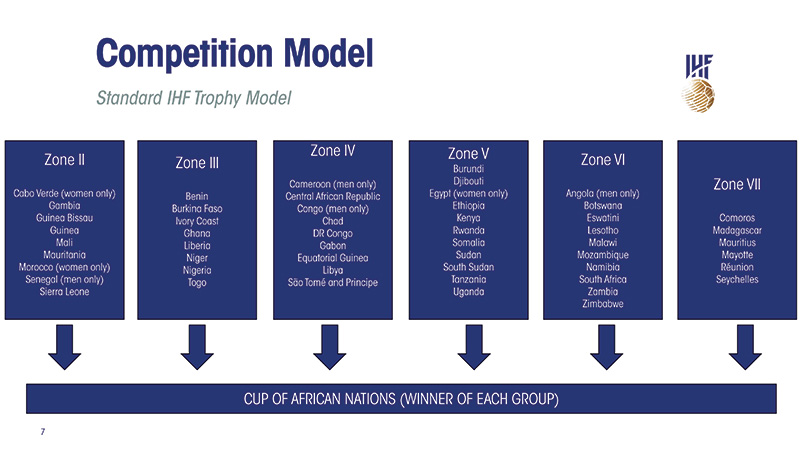
In Africa, the competition is structured across six zones featuring dozens of national federations from across the continent. The winner of each zone will earn a place at the CAHB African Championship, directly boosting participation numbers at one of the continent's flagship competitions.
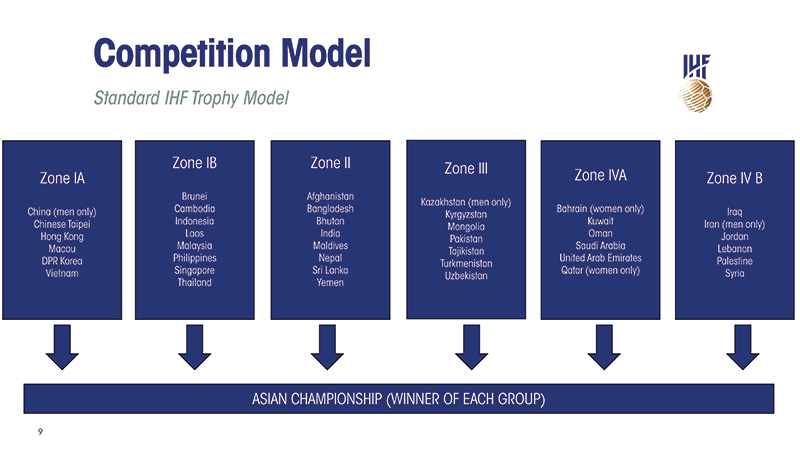
In Asia, six zones covering the breadth of the continent - from South-East Asia to Central Asia and the Middle East - feed into the Asian Championship. Zone winners qualify directly for the AHF Asian Championship, giving all nations which compete internationally a genuine pathway to the highest level of Asian handball.
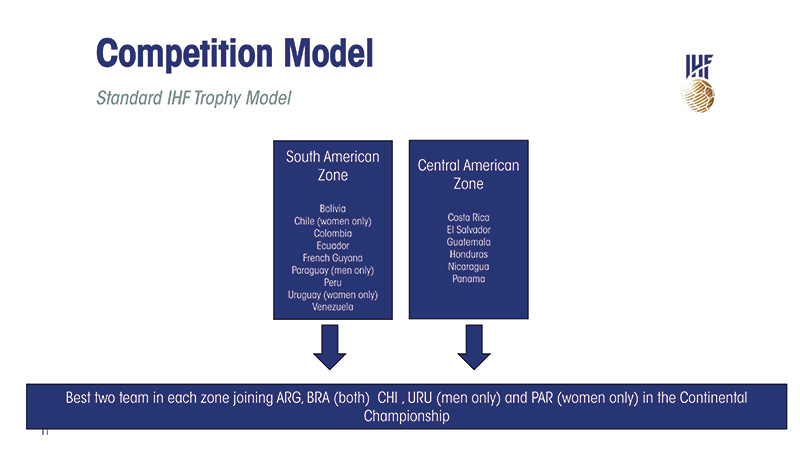
In South and Central America, the competition is divided into a South American Zone and a Central American Zone. The best two teams from each zone will join established nations such as Argentina, Brazil, Chile, Uruguay and Paraguay in the South and Central America Championship. A crucial additional benefit is that this structure guarantees the minimum number of participants required in the continental qualifications, securing the continent's World Championship qualification slots.
For North America and the Caribbean and Oceania, every national federation will be invited to participate, and the tournament will simultaneously serve as a Continental Championship. Notably, since Oceanian teams can only qualify for the World Championship through the Asian Championship, the IHF will support the winner of the Oceania competition in participating in the Asian Championship. The winner of the North America and the Caribbean competition will earn direct World Championship qualification.
For Europe, the exact details for the participation conditions for the teams are to be announced.