

Argentina and Brazil share the titles at the South and Central American Men’s Youth and Junior Championships
15 Nov. 2026
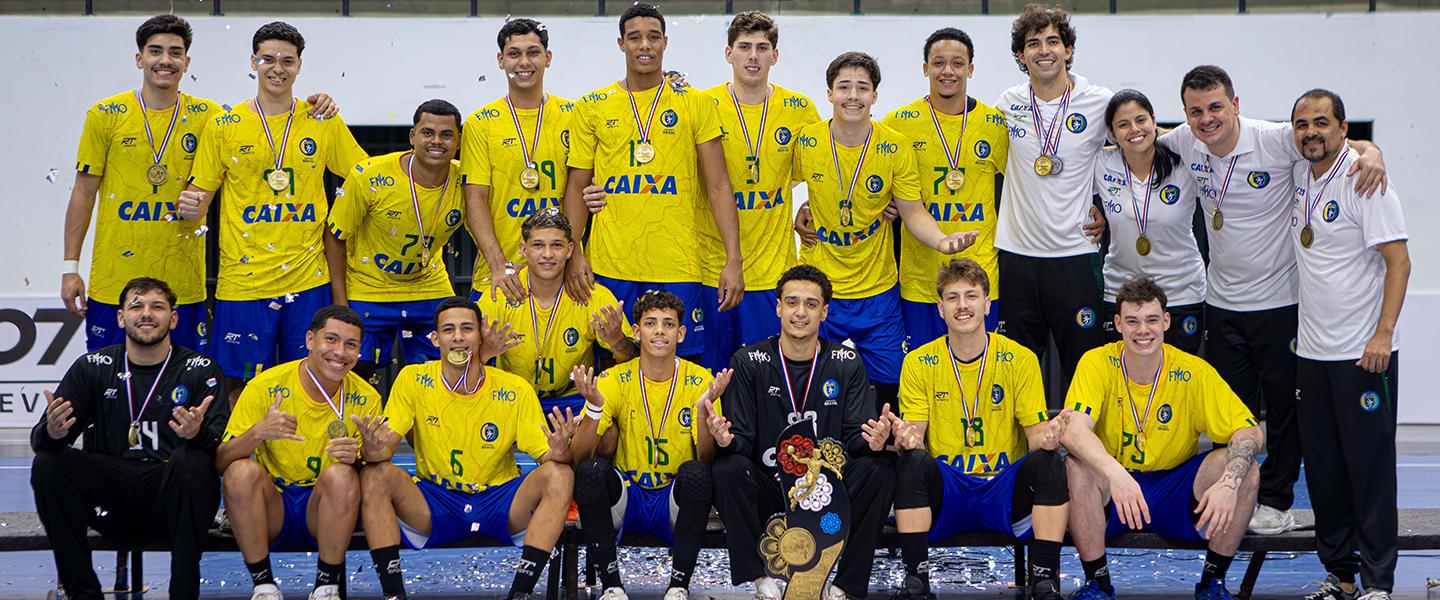
Argentina and Brazil shared the titles at the 2026 South and Central American Men’s Youth and Junior Handball Championships, which took place between 10 and 14 November in Asuncion, Paraguay.
Argentina beat Brazil, 18:15, in a low-scoring final to be crowned youth champions, while Brazil turned the tables in the junior final, 32:24, with both winners sealing the trophy after a flawless performance - five wins out of five matches.
Both competitions were played in conjunction with the Continental Phase of the IHF Trophy Men for the South and Central America Confederation. In the youth competition, Colombia, El Salvador, Nicaragua and hosts Paraguay took part, joining Argentina, Brazil, Chile and Uruguay in the mix, while Colombia, French Guiana, Guatemala and Nicaragua completed the line-up in the junior event.
In each competition, the eight teams were divided into two groups of four teams each, with the top two sides progressing to the semi-finals and the other four teams playing the Placement Matches 5-8.
Youth: Argentina’s defence makes the difference
Argentina were in a class of their own in Group B of the youth competition, dispatching Paraguay (38:9), El Salvador (53:7) and Uruguay (38:16) and conceding only 32 goals in three matches in the preliminary round. Against El Salvador, Argentina delivered unanswered runs of 11:0, 7:0, 14:0 and 13:0, with Camilo Sciglitano scoring 10 goals from 10 shots, while a 9:0 run was the highlight of the win over Paraguay and a 7:0 run, in which Uruguay did not score for 16 minutes, decided the first place in the group.
Uruguay finished second after a 51:9 win over El Salvador, which featured the largest run of the competition, 21:0 - from 1:1 to 22:1, with El Salvador kept scoreless for more than 21 minutes - followed by another 13:0 run, and a 36:16 win against Paraguay, sealed by a 10:0 run in the second half.
Group A was a much closer affair at the top. Brazil beat Nicaragua (43:16), bouncing back from a 5:9 deficit with two 8:0 runs and a 12:0 run, and Colombia (48:18), where a 12:0 run turned a 5:3 scoreline into 17:3. Chile also dispatched Colombia (46:22), with an 11:0 run, and Nicaragua (46:25), with an 8:0 run, setting up a decider for first place.
Chile started that match with a 4:0 run, led 13:8 at the break and 18:11 in the 36th minute, but did not score for almost 15 minutes in the second half, as Brazil tied the score, 20:20, and took the lead, 23:22, with nine seconds to go. Tomás Lladser equalised at the buzzer, 23:23, yet Brazil still won the group on goal difference. Nicaragua and Colombia also shared the points, 30:30, after Miguel Florez scored on the final whistle for Colombia.
In the semi-finals, Brazil were tied with Uruguay, 7:7, after 19 minutes, but a 4:0 run and a 5:0 run on either side of the break opened a 17:10 lead, and João Britto’s six goals and goalkeeper Joao Ribeiro’s 12 saves, for a 41% saving efficiency, secured a 25:17 win.
Argentina faced more resistance from Chile. Down 4:6, Argentina used a 6:0 run to take the lead, 10:6, as Chile did not score for 11 minutes, but Vicente Carvajal, who finished the match with 11 goals, scored seven times in the first half to tie the score, 14:14, at the break. Argentina opened the second half with a 5:0 run and added a 6:0 run between the 42nd and the 47th minutes to make it 28:17, cruising to a 36:24 win, with Nicolas La Delfa scoring eight goals and Juan Bautista Dirr adding seven.
The final was a defensive battle. Brazil started stronger, leading 5:2 after 14 minutes, as Argentina failed to score for more than 12 minutes, but Argentina tied the score, 6:6, in the 23rd minute and were down by a single goal at the break, 8:9. Brazil still led 11:10 in the 38th minute, but did not score again for more than 13 minutes, as Argentina’s 6:0 run turned the match on its head, 16:11.
Nicolas La Delfa was instrumental for Argentina, scoring 11 of his team’s 18 goals, while goalkeeper Francisco Perez saved 11 shots, for a 42% saving efficiency. Brazil’s Joao Ribeiro had an outstanding 15 saves, for a 48% saving efficiency, but Brazil scored only six goals in the second half and Argentina sealed an 18:15 win to lift the trophy, having conceded only 71 goals in five matches.
In the bronze medal match, Chile took a 6:2 lead against Uruguay, were pegged back at 9:9, but pulled away again to lead 19:14 at the break and secured a 36:27 win. Gaspar Serrano scored nine goals from nine shots and Vicente Carvajal added seven for Chile, while Uruguay’s Ignacio Lopez had a perfect outing, with 11 goals from 11 shots.
Junior: Brazil dominate from start to finish
In the junior competition, Brazil won Group B with wins over Colombia (42:14), Guatemala (32:13) and Uruguay (34:18), conceding only 45 goals in three matches. A 13:0 run spanning 14 minutes broke Colombia, an 11:0 run that kept Guatemala scoreless for more than 15 minutes followed, while Uruguay, who trailed by a single goal early in the second half, 13:14, were stopped in their tracks by a 15:1 run, which included a 10:0 run, as Brazil took a 29:14 lead.
Argentina secured the first place in Group A, with wins against Nicaragua (53:8), which featured two 11:0 runs and an 8:0 run, French Guiana (32:19), with runs of 6:0 and 9:0, and Chile (28:20), a match they led 16:8 at the break. Chile finished second, after wins over French Guiana (30:18) and Nicaragua (41:17), while Uruguay progressed from Group B with a 38:13 win over Guatemala, with two 7:0 runs, and a 34:24 win against Colombia.
Argentina had a difficult semi-final against Uruguay. Leading 10:5 after 19 minutes, they saw Uruguay answer with a 4:0 run and tie the score, 13:13, right after the break, but a 5:1 run restored the cushion and Bautista Torossian’s seven goals lifted Argentina to a 29:24 win.
In the other semi-final, Chile had the upper hand in the first minutes, 5:3, and were still level in the 19th minute, 8:8, only for Brazil to produce a 12:3 run over the next 23 minutes and take a 20:11 lead. George Siqueira scored nine goals and goalkeeper Muriel Soares had 11 saves, for a 52% saving efficiency, in Brazil’s 25:18 win.
Argentina started the final better, leading by two goals on several occasions, the last time at 10:8 in the 16th minute, but a 4:0 run put Brazil in front. Argentina tied the score for the last time, 13:13, in the 28th minute, only for Brazil to score four unanswered goals on either side of the break, 17:13. Argentina cut the gap to four goals twice, 19:23 and 22:26, but Brazil finished the match with a 6:2 run for a 32:24 win, with George Siqueira scoring seven goals, Brayan Rüdiger six from six shots and Diogo Borja five, while Bautista Torossian had nine goals for Argentina.
The bronze medal match was a closer affair. Uruguay led 8:7 after 16 minutes, but a 5:0 run helped Chile take a 15:10 lead at the break, which grew to 19:11 in the 38th minute. Uruguay mounted a comeback and cut the gap to two goals with 16 seconds to go, 23:25, but Chile held on for a 26:23 win.
Argentina, Brazil and Chile seal World Championship tickets
The two competitions were qualification events for the 2027 IHF Men’s Youth World Championship and the 2027 IHF Men’s Junior World Championship, with the top three sides in each competition - the teams finishing on the podium - earning their tickets for the world handball flagship events.
Argentina, Brazil and Chile will therefore represent South and Central America at both the 2027 IHF Men’s Youth World Championship, and the 2027 IHF Men’s Junior World Championship.
IHF Trophy: Nicaragua and French Guiana progress
In the Continental Phase of the IHF Trophy Men – Youth for the South and Central America Confederation, Nicaragua were the highest placed team, finishing fifth. They took a 40:34 win over El Salvador in the Placement Matches 5-8, despite Christopher Chávez Aguirre scoring 13 goals for El Salvador, the best individual tally of the two competitions, and then beat Paraguay, 30:26, in the Placement Match 5-6, with Oscar Lopez scoring 10 goals and goalkeeper Dilan Shippley saving 14 shots. A 6:0 run early in the second half, which opened a 22:13 lead, was the key moment of the match.
Hosts Paraguay had previously edged Colombia, 33:31, after a penalty shoot-out. Down 17:21, Paraguay kept Colombia scoreless for 13 minutes and used a 6:0 run to take the lead, 23:21, but Jeronimo Vasquez, who scored 10 goals including one in the shoot-out, tied the score on the buzzer, 28:28. Colombia ended seventh, with a 38:28 win over El Salvador in the Placement Match 7-8, with Isaac Lopez scoring 12 goals.
In the junior competition, French Guiana were the highest placed IHF Trophy team. Down 5:9 against Guatemala, they turned the match around after the break for a 28:19 win in the Placement Matches 5-8, where Colombia beat Nicaragua, 39:22. In the Placement Match 5-6, Colombia led 5:1 early on and 13:10 at the break, but did not score for more than 13 minutes in the second half. French Guiana were up 20:18 with three minutes to go, Cristobal Lopez Gomez scored twice in the last minute to tie the score, 20:20, but French Guiana won the penalty shoot-out, 4:1, for a 24:21 win. Nicaragua ended seventh, with a 28:23 win over Guatemala.
Therefore, Nicaragua qualified for the Intercontinental Phase of the IHF Trophy Men – Youth, while French Guiana qualified for the Intercontinental Phase of the IHF Trophy Men – Junior.
The top scorers of the youth competition were Argentina’s Nicolas La Delfa and Colombia’s Isaac Lopez, with 31 goals each, followed by Chile’s Vicente Carvajal and El Salvador’s Christopher Chávez Aguirre, with 28 goals each.
In the junior competition, Brazil’s George Siqueira was the top scorer, with 32 goals, followed by his teammate Marcos Oliveira, with 25 goals, and Argentina’s Francisco Colombo, Colombia’s Martin Montoya Arcila and Nicaragua’s Adan Urbina, with 23 goals each.
Final rankings
Youth: 1. Argentina, 2. Brazil, 3. Chile, 4. Uruguay, 5. Nicaragua, 6. Paraguay, 7. Colombia, 8. El Salvador
Junior: 1. Brazil, 2. Argentina, 3. Chile, 4. Uruguay, 5. French Guiana, 6. Colombia, 7. Nicaragua, 8. Guatemala
Photo credit: Handball SCA / Jorge Olmedo