
More than a Championship: how the 2025 IHF Women's World Championship left its mark on Rotterdam and the world
10 Mar. 2026
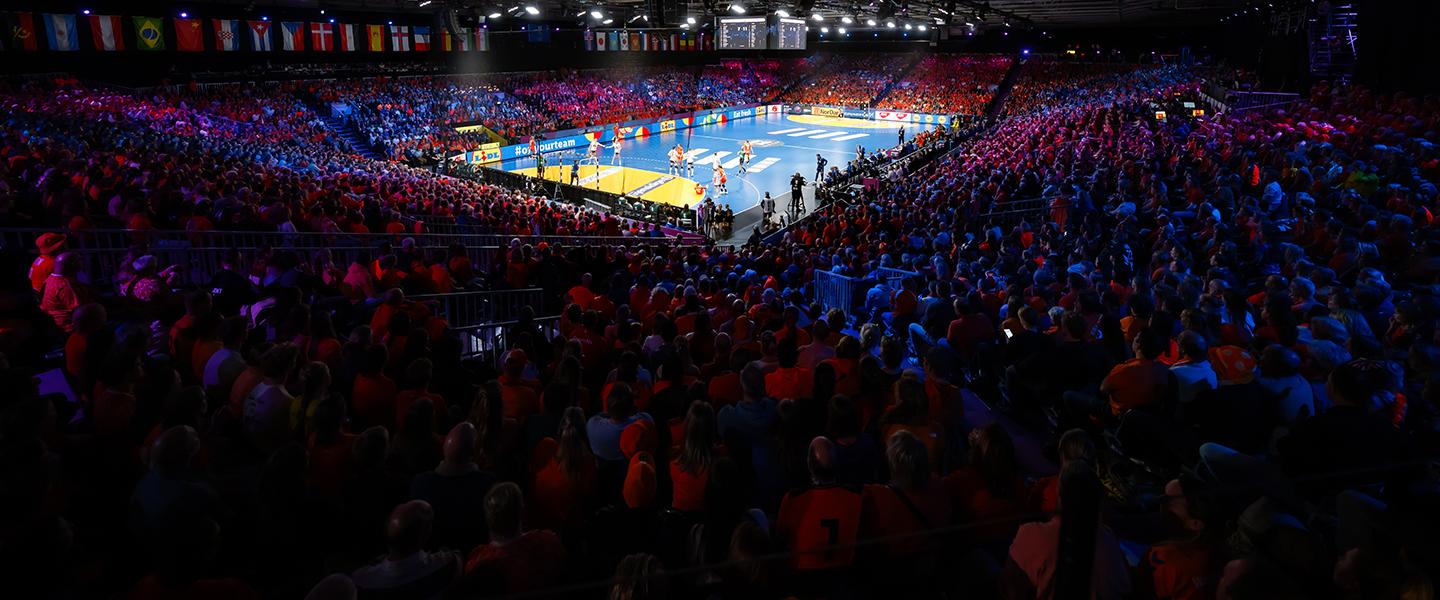
Some sporting events leave a city unchanged. Others transform it into something vibrant, more connected and more alive. The 2025 IHF Women's World Championship, which took place in Germany and the Netherlands between 26 November and 14 December 2025 was firmly in the second category. When the final whistle blew at Ahoy Rotterdam, the numbers told a story about a sport elevated and audiences captivated across the continent.
Rotterdam: a city that rose to the occasion
The impact on Rotterdam was immediate, measurable and lasting. According to a comprehensive audience study conducted by R2 Research and Cigarbox, in collaboration with the organisers - the Nederlands Handbal Association, TIG Sports and Events, SportVibes and Rotterdam Topsport - visitor spending generated an estimated €7.7 million for the city. That figure is considerably above the average for comparable sporting events of similar duration, and it reflects the scale and reach of an event that drew fans from across the Netherlands and beyond.
According to the study published by the Dutch Handball Assocation, 88 per cent of Dutch visitors travelled from outside the Rijnmond region to attend, underlining the tournament's national and international appeal.
The tournament also reinforced Rotterdam's growing reputation as a world-class host city for major sporting events. 65 per cent of visitors agreed that the World Championship demonstrated Rotterdam's ability to support sporting talent and provide a home for elite sport, with the city experienced throughout as welcoming and innovative.
Inside the arena: an experience that resonated
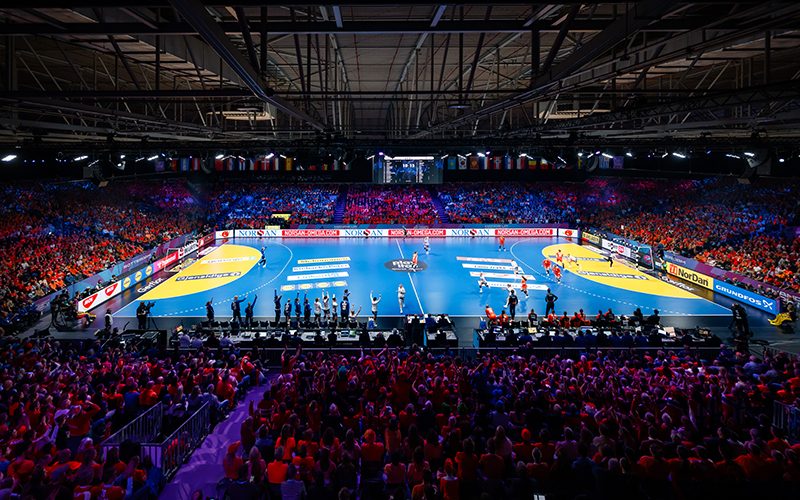
The figures from the fan satisfaction survey were, by any measure, exceptional. Based on more than 1,800 respondents, 68 per cent of visitors said they would recommend the World Championship to friends, family or colleagues with just 2 per cent saying they would not. The resulting Net Promoter Score of +66 is a very strong indicator of satisfaction and engagement, and one that places this event among the most positively received sporting occasions staged in Rotterdam in recent years.
When visitors were asked to rate specific aspects of their experience, the atmosphere stood out above all else, earning a remarkable average score of 9.4 out of 10. Staff hospitality (8.8), family-friendliness (8.6), the venue itself (8.6) and accessibility (8.5) all received high marks, a well-rounded result that reflects the care and professionalism invested in every dimension of the event by the local organising committee and the IHF.
The profile of the audience itself was striking. A third of all visitors were under 18 years old, a statistic that bodes extremely well for the future health of the sport in the Netherlands and beyond. Perhaps even more notably, 64 per cent of attendees and 61 per cent of ticket buyers were women, a demographic profile that sets the Women's World Championship apart and reflects the unique ability of women's handball to build a deeply engaged fanbase.
Although 69 per cent of visitors were current or former handball players, 37 per cent still active, the proportion of non-handball-affiliated attendees was higher than at several other major international sporting events held in Rotterdam, including the ABN AMRO Open, the Volleyball World Championship and the Short Track World Cup. That broader appeal is precisely what transforms a sporting event from a gathering of the converted into a genuine cultural moment for a city.
Millions watching across Europe
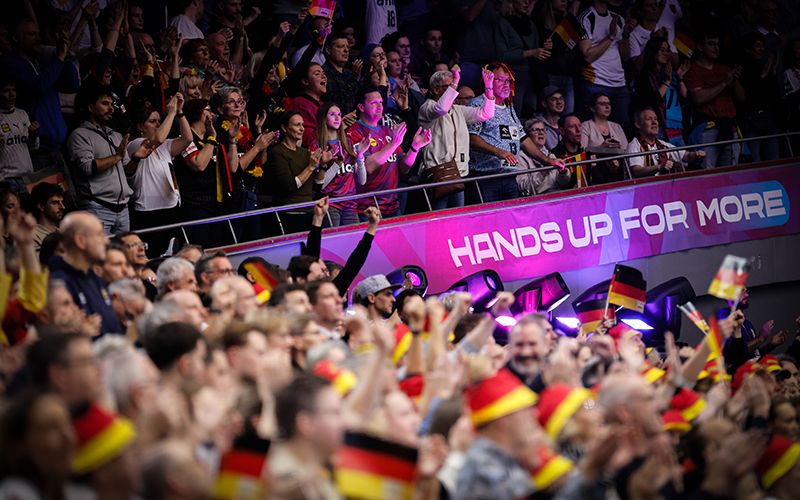
The story inside the arena was matched, and in some markets exceeded, by the story on television screens across the continent. In Germany, where the national team's historic run to the final, their first since 1993, captivated an entire nation, the final on ARD drew an average of 5.79 million viewers and a 31.1 per cent market share. Among the 14-to-49 age group, 1.27 million young viewers tuned in, delivering a 37.1 per cent share and the outright victory for the time slot across all of German television. The semi-final against France drew 3.09 million viewers (20.1 per cent share), while the quarter-final against Brazil on ZDF brought 2.50 million viewers and a 17.4 per cent share.
In Norway, the semi-final against Germany averaged 879,000 viewers, peaking at 1,120,000, with a 78.5 per cent commercial share, meaning roughly one in six Norwegians was watching that single match and four out of five TVs which were on were tuned into the match. The quarter-final against Brazil drew 553,000 viewers and a 58.8 per cent commercial share. In Denmark, broadcaster DR reported 1,045,000 viewers and a 67 per cent share for the preliminary round match against Hungary, and 971,000 for the semi-final against France.
In France, TFX's semi-final coverage peaked at 740,000 viewers, while in the Netherlands, domestic audiences grew steadily as the host nation progressed, with the semi-final against Norway drawing 289,000 viewers. Across all markets, the pattern was consistent: the deeper the tournament went, the more people watched.


Top