
"Hands up for more": 2025 IHF Women's World Championship sets new benchmark
14 Dec. 2025
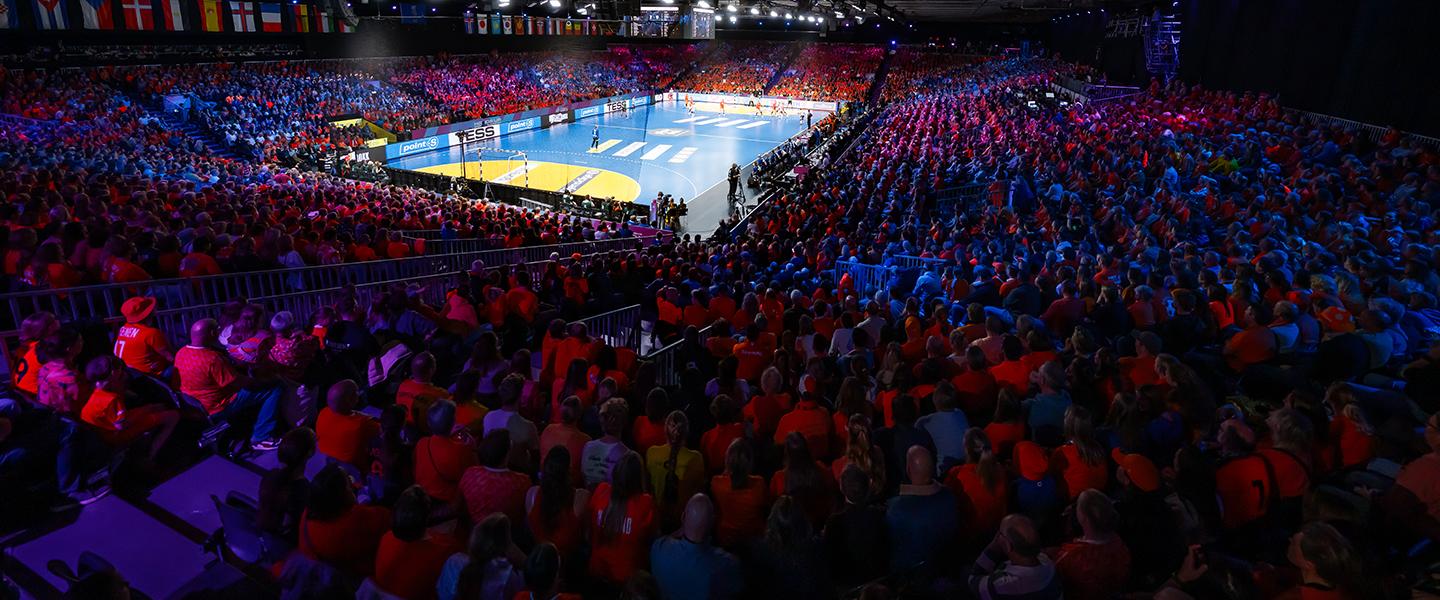
The 2025 IHF Women’s World Championship has set a new benchmark for elite women’s handball, both on and off the court. With 32 nations competing, 108 matches played, and a record 354,029 spectators in the arenas before the final day, the event showcased a sport in clear, dynamic growth. From organisational excellence to rising global competitiveness, this edition underlined why women’s handball has become a dynamic and interesting part of international sport.
World-class organisation and atmosphere
Co-hosts Germany and the Netherlands delivered a tournament of outstanding quality, with modern venues, strong logistics, and a vibrant fan experience in every host city. The atmosphere in arenas such as Rotterdam’s Ahoy and the packed German halls created a powerful backdrop for the players and contributed to the record attendance figures – with 354,029 spectators before the final day, beating the previous record set at the 2023 IHF Women’s World Championship, when 344,399 spectators took the court.
“This edition of the IHF Women’s World Championship has once again been a great success from a competition standpoint, with 32 top nations fighting for the title and delivering high-quality handball across the entire event”, said Per Bertelsen, Chairman of the IHF Commission of Organising and Competition (COC).
“For the first time, Germany and the Netherlands co-hosted the championship, offering world-class conditions and atmosphere in multiple venues and showcasing the passion for handball across both countries. Everyone involved – local organisers, national federations and city partners – did a fantastic job in staging an outstanding event.”
More than 2,000 volunteers formed the backbone of the event, ensuring that operations ran smoothly and that teams and spectators alike were supported at every stage. Their contribution underpinned a championship that was widely regarded as professionally run, athlete-centred, and fan-friendly.
Strong officiating and new levels of transparency
Refereeing at this edition was assessed positively, with performances across the over 100 matches, generally at a high standard despite the increasing speed and physicality of the sport. The number of suspensions and direct red cards remained stable or slightly improved compared with recent tournaments, indicating consistent criteria and game management.
“We see the situation of the referees as more challenging as the game development is creating more and more one-on-one duels. This gives the referees more decisions to take, both on a technical level, but also regarding body contact. We cannot demand that referees in such a high paced in dynamics sport are going through matches without making mistakes. Very few of them have had influence on the final result of the matches, but this will of course also unfortunately happen. We have big respect for the referees and the job they are doing and they have our full confidence. No mistakes are made intentionally, and our experts are going through every match with them in a detailed way,” said Per Morten Sødal, the Chairman of the Playing Rules and Referees Commission (PRC) of the IHF.
A dedicated support structure for referees – including technical experts, mental and physical coaches, and medical staff – reinforced quality and consistency. Newly introduced communication tools such as microphone announcements after video reviews (RefMic) and referee‑camera footage broadcasted live in the video feed on TV further increased transparency, strengthened the connection with spectators and television audiences, and offered valuable material for education and analysis. Feedback from teams, officials, and broadcasters on these innovations has been strongly positive.
“To reflect our sport as a world sport we also need referees on high level from more continents than Europe. In this championship eight out of the 22 couples are from continents outside Europe. Especially the referees from the South and Central American Handball Confederation has shown really positive performance, culminating with that the couple from Uruguay were nominated for the bronze medal match,” adds Sødal.
“Only five of the couples in the tournament are female couples. We believe in diversity, so this is clearly lower than we want. Injuries, pregnancies and retirements are a part of the explanation, with developing more elite female referees is also a clear task for us”.
High-performance handball and growing global balance
On the court, the 2025 IHF Women’s World Championship underlined the remarkable level of modern women’s handball. The top nations maintained very high standards while many other teams significantly reduced the performance gap. Attacking efficiency, tempo, and tactical sophistication all reached or surpassed previous peaks, producing attractive, fast games and very few low-quality matches. The vast majority of games were competitive, with a large share decided by small goal differences, including in the knock‑out phase.
“For the best eight teams in the tournament, the number of attacks reached an average of 56.8 per match, with the average attack lasting just 31.7 seconds. This reflects the consistently high tempo and fast transition game demonstrated by the leading sides.
Counter-attacks in first and second waves played a key role, repeatedly creating numerical superiority in the opponent’s half. The co-organiser, the Netherlands, together with France, scored the most goals from this high-speed style of play. Overall scoring also reached new heights: similar to the men’s World Championship earlier in the year, an all‑time record of 64.0 goals per game was achieved, surpassing the previous peak of 60.8 goals from 2003,” said Dietrich Späte, the Chairman of the IHF Commission of Coaching and Methods (CCM).
“Attacking effectiveness – distinct from pure shooting efficiency – remains one of the most important indicators of quality. After dropping to 52.9% for the top eight teams in 2023, it climbed to a new 20‑year high of 56.4% in 2025. Norway led the way with an outstanding attacking effectiveness of 61.7%, approaching the benchmark values seen in elite men’s handball, where, for example, world champions Denmark convert around two out of three attacks. Reducing technical errors is another crucial quality marker. Compared with 2023, when teams averaged 11.8 technical faults per game, the figure fell to 11.2 at this World Championship. Hungary set the standard here with only 9.1 errors per match.”
At the same time, teams from outside Europe made clear progress, reaching higher positions and recording important wins against established European powers. This development confirmed the value of the current tournament format for global growth: participation on the World Championship stage is a sporting catalyst in emerging handball countries.
Non‑European teams showed clear progress. In 2023, only Brazil (ninth) and Angola (15th) finished in the top 16. In 2025, Angola climbed to the tenth place, Brazil reached the quarter‑finals and finished a highly respectable sixth, and Japan secured 13th place to become a third non‑European nation in the top 16. Through their victories against European opponents, these three countries underlined that they are fully competitive at the highest level of international women’s handball. Tunisia and Senegal likewise demonstrated noticeable improvement compared with previous tournaments.
more topics


Top