
Weaving history for the Cook Islands in Croatia
25 Jun. 2026
It is likely that you have never heard of Tongareva (Penrhyn), an atoll and northernmost island in the northern group of the Cook Islands in the south Pacific Ocean.
Home to two villages – Omoka and Te Tautua – it has a total population of around 200 and is just under 1,500km away from the capital of the Cook Islands, Rarotonga.
It is a spectacular, beautiful, remote and sparsely-populated geographic location, an almost circular coral atoll around 80km in circumference enclosing a lagoon of around 235 square kilometres atop a submarine volcano. And it was a place that Cook Islands pivot and right wing, 35-year-old Nanave Taime Goodwin, once called home.
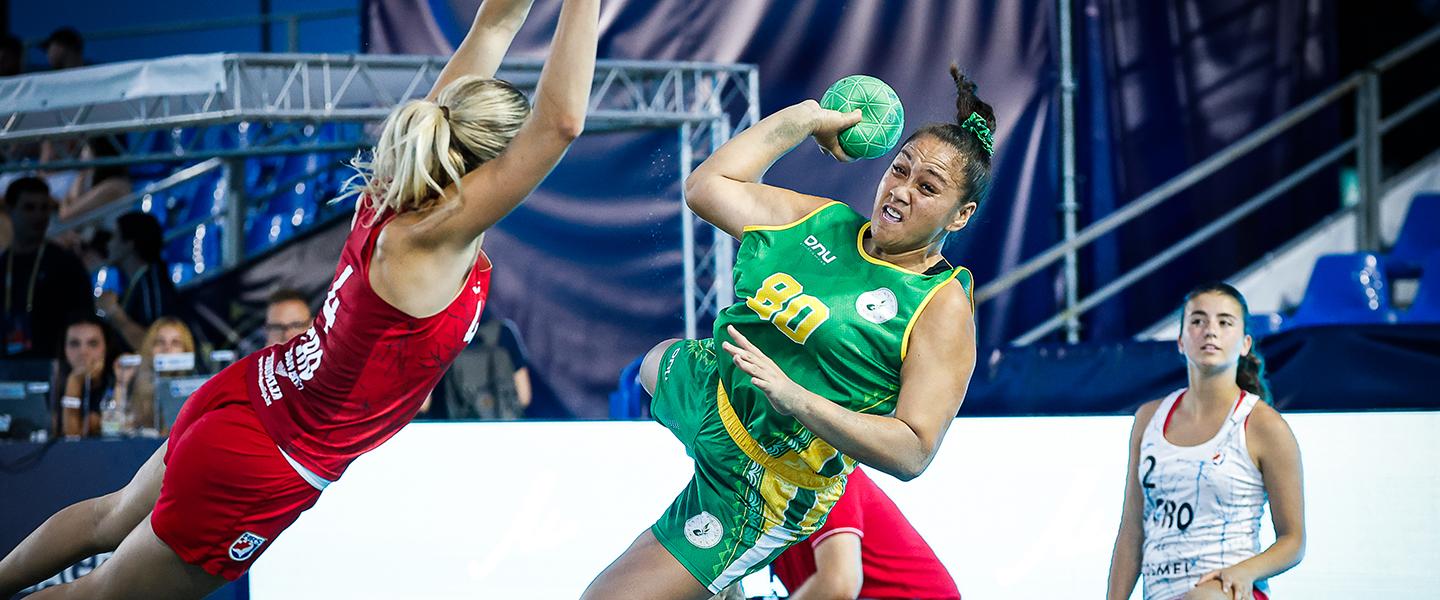
16,000km away from Tongareva is Croatian capital Zagreb, where Taime finds herself now, competing for her country at the 2026 IHF Women’s Beach Handball World Championship.
“Tongareva is far away from the mainland, Rarotonga, about four hours by flight, and it’s just a small, tiny island but it's quite special to me,” explains Taime to ihf.info who was born in Rarotonga, but raised in Tongareva before moving back to Rarotonga where she has been for the past 16 years.
“It’s got two villages and has the most beautiful and biggest lagoon in the Cook Islands which makes this island special – our lagoon is beautiful; it has everything inside.”
Taime, like all the athletes at Croatia 2026, is not a full-time, professional beach handball player, which means a source of income and a day job is needed.
But her job is one that is inextricably linked to Tongareva and its ancestors: weaving. The traditional knowledge and art which was passed down to her by her grandmother.
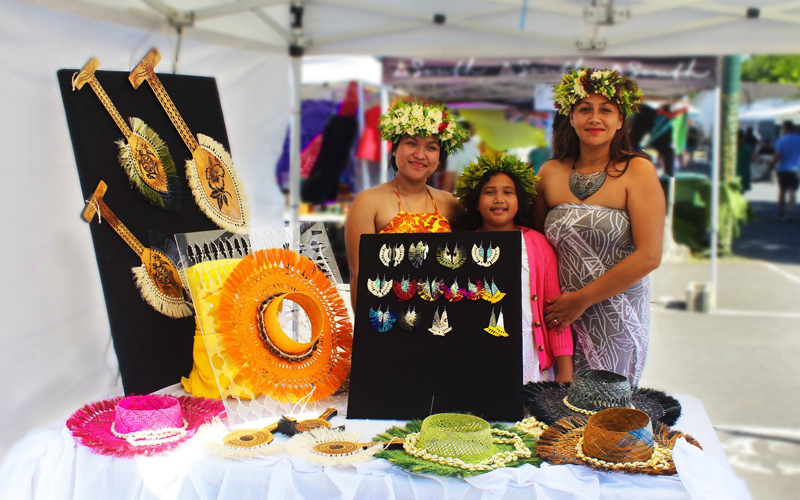
One material Taime uses in weaving is 'Rito' which is from the coconut tree leaf. The fibre is separated from the leaf, boiled and dried leaving a fine white leaf before being used to weave all sorts of different items, including hats, some of which have been given as gifts by the Cook Islands at Croatia 2026.
“For the women in Tongareva weaving is part of our traditional life, starting as young girls – men do the fishing while weaving is just for the women. At a young age you must learn; it’s part of our traditional life, passing through generation to generation and I am a weaver as well,” explained Taime, who started being taught the art when she was around nine years old by her grandmother after following her to where she used to weave with other women on the island and being inspired.
“I've turned weaving, my passion, into a living for me. I've got a small business and actually got orders at the moment, but my clients understand – I sell to lots of place worldwide. My clients are very humble and can't wait until I return back and continue my work.
“In fact, in our team, we have players from islands with other crafts, like a few players from Atiu, one of our southern islands, plus our goalkeeper is from Manihiki, a sister island to my island and an island which is where our famous Cook Islands black pearls come from so their craft is that. Where I’m from, our crafts are handcrafts mainly.”
While Taime sells across the Cook Islands as well as Hawaii, America, Canada, American Samoa, Samoa, Fiji, Tonga and other locations, her and her beach handball teammates faced Spain, Croatia and Puerto Rico in the preliminary group of their debut world championship and their own handiwork on court was evident to see.
Despite losing all three games 2-0, they were close to grabbing a set off of Puerto Rico, had the chance to open the scoring against 2016 world champions Spain and led host nation Croatia in the first set early on (4:2, first set).
“Spain were the next level,” she said. “We had watched their games on YouTube before and we were expected to have this type of blow-out, but it was exciting and full of surprises. Even though we lost, we're here,” said the player about the 2-0 (30:7, 20:6) defeat.
“We had a better defence in the second set, but it was a bit of nervousness at first. The Spain game was a really, really good learning for us: our first game in a world championship was against one of the best teams – and champions from 10 years ago.”
“It felt surreal, very surreal getting that first goal, and it's a motivation,” added former netball player and teammate of Taime, Mariana Ngauta, who scored her country’s first-ever senior world championship points, in the opener against Spain.
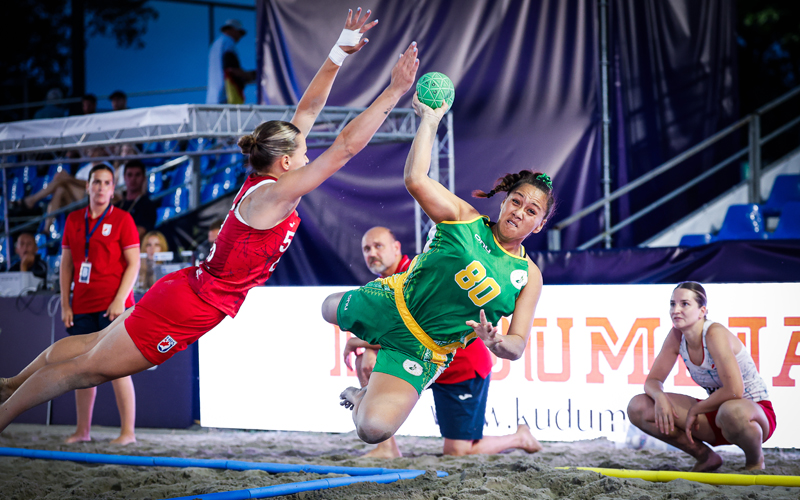
“I love the fast-paced physical contact; it’s similar to netball. I’ve transferred my netball skills into beach handball and it's given me that passion to grow the sport. We’re just playing hard for this world championship, just flying our flag out there for everyone to see and playing the best that we can. We've received so much support back home, so that’s what we want to do for our families and friends in our country.”
10 years ago, Nanave was one of the original attendees when then IHF expert and coach of the Australian women’s beach handball team, Boris Mensing, delivered an introductory course in 2016.
“They flew us over to Rarotonga and taught us. There was a few of us that went there; me, my coach and one of the players in the team. We were the very first ones when they introduced the sport to us,” said Nanave, reminiscing with a big smile.
“We went because we already played indoor, so when we heard about it, we thought, ‘that's pretty cool’. We did the spinning and everything else, but since then, we’ve come a long way, and I’m so happy thinking about from where it first started and now being here in Zagreb.
“I’m just really honoured to be here. It's a big deal for our small nation and a big deal for me as well to represent my small nation, my island and my people – we’re here to do our job, and we're going to keep trying to finish it, so our nation will be proud of us.”
While Nanave hopes to pass on her traditional weaving skills and passion to her two young daughters, she also admitted she would love to be a future beach handball coach, taking a team to another world championships, just like current coach, Paul-Luiz Van Eijk, has done for Croatia 2026.
“The biggest step we can take out of the preliminary group experience is the realisation that we're here now,” explained the coach, who was also part of the coaching staff for the Cook Islands men’s youth team at the 2025 IHF Men’s Youth Beach Handbal World Championship last year.
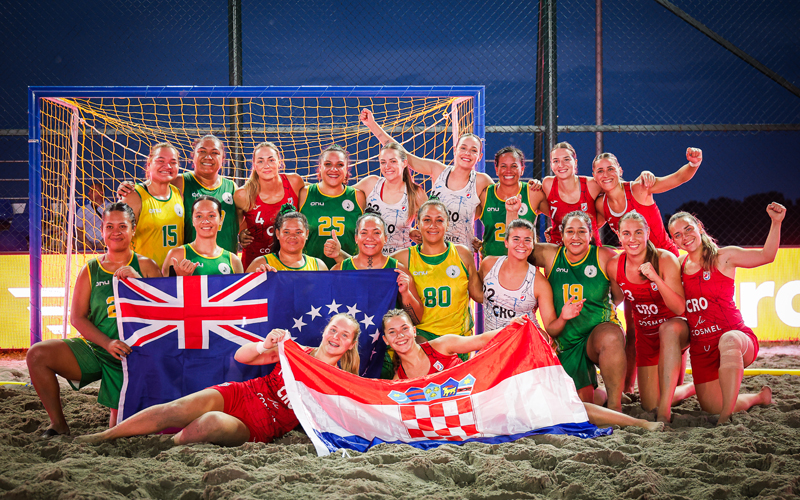
“Everything has been so overwhelming, but what a feeling, what an atmosphere and what a privilege and honour to be given this opportunity to help our little country grow in the sport of beach handball. This is the level we need to achieve. It's good now we have a senior team that has seen it, understands it, and hopefully when we go back home, we can progress and build it up again.
“I really want to acknowledge the fact that we can do it,” he added about what he wants to feel on the way home to the Cook Islands after the championship has ended, one they qualified for after Australia declined the continental qualification spot.
“I mean, yes, certain circumstances gave us this opportunity, but we've got to take the opportunity and just be absolutely thankful for it,” he added. “We're not just playing for the Cook Islands; we're playing to represent Oceania. I hope that by the time we are departing they feel accomplished, they feel proud, they feel happy. Most of them are mothers and they're happy if their child is happy seeing them achieve these things, and that's all we can hope for.”
Follow Nanave Taime’s weaving handicraft skills via her Instagram and Facebook accounts.
Weaving photo: FB/nanavecrafts
more topics
Top