
Classification process sets up the tone ahead of the 2026 IHF Wheelchair Handball World Championship
15 Sep. 2026
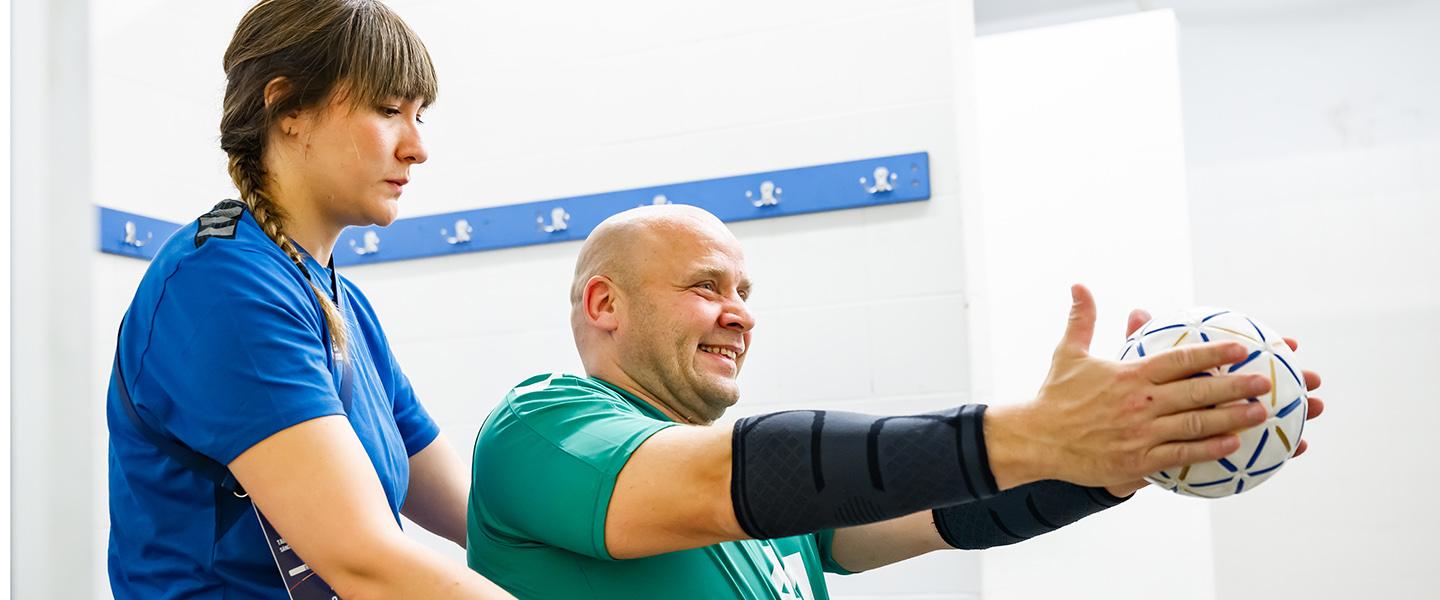
The final preparations for the 2026 IHF Wheelchair Handball World Championship are underway in Granollers, where the classification process for participating players took place on 14 and 15 September at the Palau d'Esports de Granollers, ahead of the start of the fourth edition of the competition.
With 12 teams from all six IHF continental confederations taking part for the first time, classification represents an essential part of ensuring that the competition can be conducted under the same sporting principles across such a geographically diverse field.
The IHF Wheelchair Handball Classification Rules and Regulations establish classification as the framework used to determine eligibility and allocate players to sport classes according to how their eligible impairment affects their ability to perform the specific activities fundamental to wheelchair handball. The system is designed to minimise the impact of impairment on sporting results, so that performance can determine the outcome of competition.
For the Granollers event, players from Australia, Brazil, Chile, India, Japan, United States of America, Spain, France, Libya, Lithuania and Portugal were scheduled across the two evaluation days. The timetable accounted for 43 players in the scheduled evaluation sessions, ranging from 45-minute individual windows to longer blocks for larger groups. Players whose classification status require observation assessment will be handled separately during competition.
The process was overseen by an experienced international panel. Kees van Breukelen, Benoit Sechet, Tamara Sanchez, Ahlem Benamara, Karina Sà and Andrea Totzke-Thurm served as the classifiers responsible for the evaluations in Granollers, while Brianna Thompson participated as a trainee classifier.
The work carried out over the two days followed the IHF's established classification framework. The regulations define four principal stages: verification of an underlying health condition, assessment of an eligible impairment, assessment against the relevant minimum impairment criteria and, finally, allocation of a Sport Class and Sport Class Status.
The evaluation examines the extent to which an eligible impairment affects the player's ability to execute the movements and activities required in wheelchair handball. The classification rules make clear that classification is not an assessment of sporting ability or performance. A player who becomes a better handball player does not change sport class simply because their sporting performance improves.
For wheelchair handball, that assessment is directly connected to what happens on court. The IHF system takes into account the functional impact of eligible impairments when players perform activities fundamental to the discipline. This ensures that players are assessed in relation to the demands of wheelchair handball itself rather than according to a general measure of disability.
The integrity of that process depends heavily on the expertise and independence of the classifiers. Under the IHF regulations, a classification panel must normally include at least two classifiers, with at least one member holding a different nationality from the player being assessed.
The classification personnel are also required to maintain the dignity, welfare and confidentiality of the players throughout the process. The IHF Classification Personnel Code of Conduct requires classifiers to act as neutral evaluators and to perform their duties respectfully, competently and objectively.
The IHF regulations require an Observation Assessment (OA) during competition when applicable, allowing the classification panel to assess whether the relationship between impairment and sporting performance observed during a match is consistent with the preceding assessment. The classification rules specifically include the Observation Assessment as part of the classifier's responsibilities and learning requirements.
The result of the process will be reflected on court through the sport classes allocated to the players. In four-a-side wheelchair handball, classification also feeds directly into the composition of teams, as the sport uses a points-based system to balance the functional profiles of players on court.
A colour code will then be used to identify the class of each player. A sticker with the code and the player’s number will be placed on the back of the wheelchair. There are four classes:
Class 1: green (1 point)
Class 2: yellow (2 points)
Class 3: blue (3 points)
Class 4: red (4 points)
A team cannot introduce players which total more than 11 points on the court at any given time.
For the first time, the IHF Wheelchair Handball World Championship will bring together teams representing all six continents, with Australia providing Oceania's first participation in the competition and Libya, Spain and Lithuania also making their Four-a-Side World Championship debuts. The classification process in Granollers is therefore an important part of preparing a record field and applying the same sporting framework to players arriving from very different wheelchair handball environments.
more topics
Top